Plastic Mould Manufacturers and Injection Moulding Companies in Australia
Finding the right plastic mould manufacturer in Australia starts with one question: do you need a tool, finished parts, or both? Most lists mix toolmakers and moulders together, which makes them hard to compare.
Summary
Finding the right plastic mould manufacturer in Australia starts with one question: do you need a tool, finished parts, or both? Most lists mix toolmakers and moulders together, which makes them hard to compare.
This guide divides suppliers into three groups, using what each company says on its own website. It includes Forge Labs, with a note on where we fit and where another supplier may suit you better. It also covers the real cost of offshore tooling, the non export tooling trap, ten questions to ask before you sign, and a simple way to match your volume to the right supplier.
Key takeaways
- Decide first whether you need a mould maker, a moulder, or one supplier that does both.
- Toolmakers like Prime Tooling and C&S Engineering and Toolmaking focus on building tools, while moulders like Piber Plastics and Metplas focus on running parts.
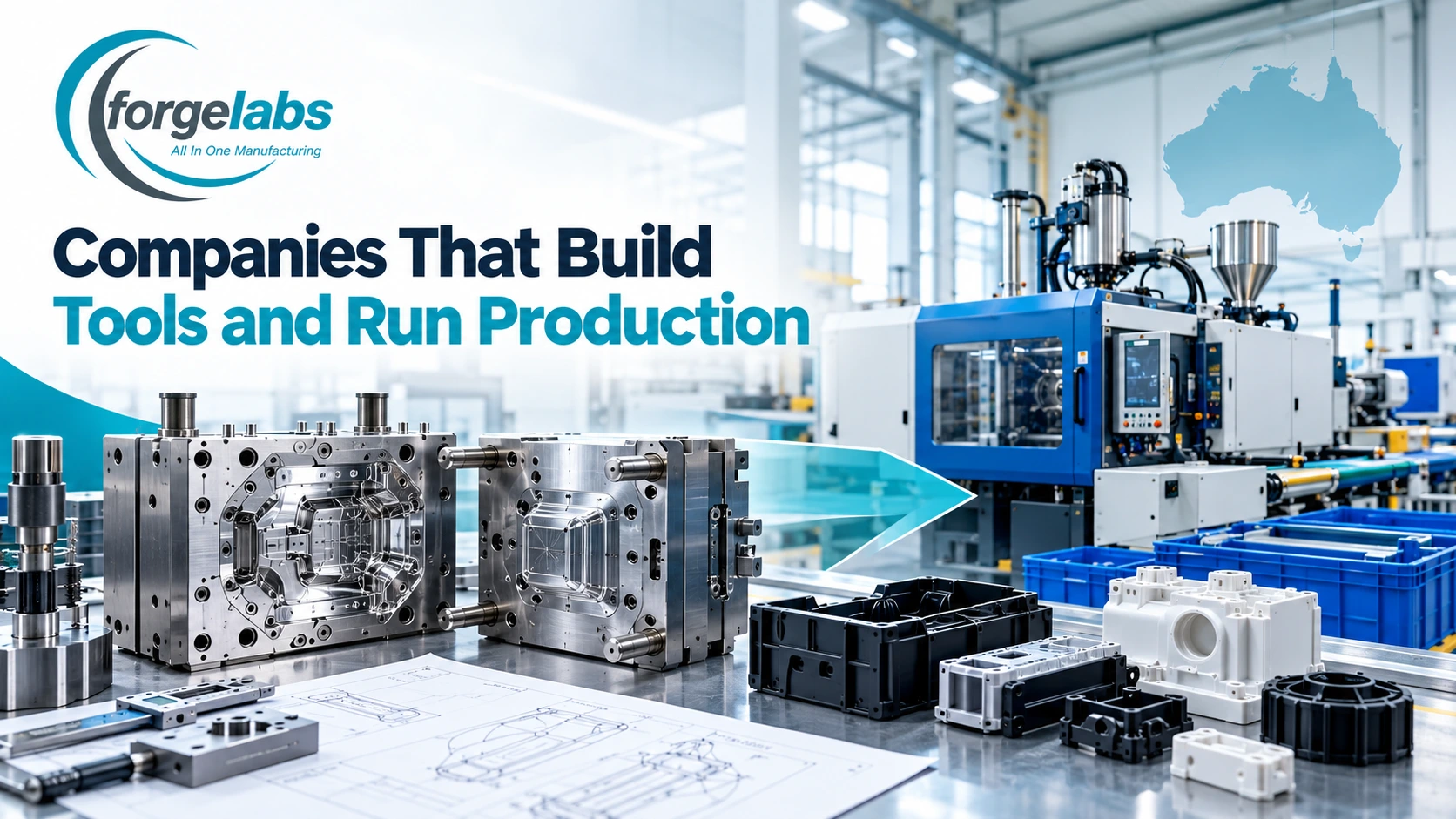
- Toolcraft, Supaflow Engineering, SDI Plastics, Sneddon & Kingston and Anchor Plastics say they build tools and run production.
- Many Australian moulders already mix local and overseas toolmaking, so ask who manages the risk, not just where the tool is made.
- Offshore quotes often look cheaper, but freight, duty, GST, inspection and delays change the total. GST registered businesses may be able to claim GST back.
- Ask in writing whether a tool is export or non export, who owns it, and how many shots it is built for.
- Aluminium tools suit hundreds to a few thousand parts, and hardened steel tools pay off at higher volumes.
- Check every company detail directly with the supplier before you send a drawing.
Written by the Forge Labs team. Company details last checked in October.
Quick answer
The right plastic mould manufacturer depends on what you need built. If you need a tool, look at toolmakers such as Prime Tooling and C&S Engineering and Toolmaking. If you need finished parts, look at moulders, and some focus on a niche, like Piber Plastics for rigid packaging or Metplas for medical, electrical and marine parts. If you want one supplier for both jobs, Toolcraft, Supaflow Engineering, SDI Plastics, Sneddon & Kingston and Anchor Plastics all say they build tools and run production. For smaller runs and product teams, Forge Labs is another option.
Why this search confuses so many buyers
Type "plastic mould manufacturers" into Google and you get a mixed bag. Some results build moulds. Some run parts. Some do both. Most lists never tell you which is which.
That matters because the wrong choice costs real money. A company that only moulds parts may send your tool to someone else. A company that only builds tools may not run your production. If you don't know the difference, you will compare the wrong companies.
This guide fixes that. We sorted each company by what it says it does, so you can shortlist faster.
Three kinds of supplier, in plain words
Mould makers (toolmakers). They design and build the steel or aluminium tool that shapes your part. They don't always run the production.
Injection moulders. They run the machines that make your parts. Some build their own tools, and others buy them in.
Both under one roof. One company builds the tool and runs the parts. You get one contact and one place to point at when something goes wrong.
How we built this list
We did not invent scores. A rating out of 10 with no method looks nice, but it tells you nothing.
Instead, we grouped companies by what they say on their own websites, and we looked at five things:
- Do they build tools, run parts, or both?
- Which machine sizes do they list?
- Do they say they have an in house toolroom?
- Which industries do they serve?
- Where are they based?
Some of these websites look older than others, so confirm the basics before you rely on them.
Companies that build tools and run production
Toolcraft (Melbourne). Toolcraft says it runs a toolroom and a moulding floor together. It lists 16 injection moulding machines from 25 to 450 tonnes, plus warehousing and logistics for your parts. That suits buyers who want tools built and parts stored and shipped by one supplier.
Supaflow Engineering (Meadowbrook, Queensland). Supaflow runs its moulding around the clock. It lists more than 15 machines from 100 to 450 tons and says it moulds parts up to 1,300 grams. It also offers prototyping and CNC tool making, and it says it builds tools in its Australian workshop and through a partner factory in China.
SDI Plastics (Brisbane). SDI describes a local toolroom for building, repairing and maintaining tools, plus tooling partners in Malaysia, China and North America. It also says it takes on existing moulds, which helps if you want to bring production back to Australia.
Sneddon & Kingston (Preston, Melbourne). This company covers design, prototypes, tooling and production. It says it builds tools in house and guarantees and maintains them while they run in its factory. For medical work, it says it can supply certifications you may need for the FDA or TGA in relation to tooling.
Anchor Plastics (Taren Point, NSW). Anchor says it has moulded in Australia for over 40 years. Its list includes tool design and making, custom moulding, assembly, testing, finishing and packaging. That wider list suits buyers who want parts that arrive ready to use.
Companies that focus on tools
Prime Tooling (Kings Park, NSW). Prime Tooling says it was established in 1999 and specialises in plastic injection moulds. It lists experience with tricky features like slides, angle lifts, collapsible cores and unscrewing moulds. If your part has undercuts or threads, a specialist like this is worth a call.
C&S Engineering and Toolmaking (Smeaton Grange, NSW). C&S says its own toolmakers build every tool it supplies. It explains the range clearly, from simple tools cut straight into the plates to complex tools with hardened inserts. It also warns that glass filled plastics are abrasive and can wear a tool faster, which is a useful tip for any buyer.
Moulders with a clear focus
Piber Plastics (Derrimut, Victoria). Piber is an Australian owned moulder that says it has operated since 1999. It makes injection and blow moulded products, mainly rigid packaging for food and consumer goods, and it offers in mould labelling and an in house design team. If you sell packaging, start here.
Metplas (Dee Why, NSW). Metplas is a family business that makes moulded parts for medical, electrical, marine, technical and startup customers. It lists six automated machines, with two Engel machines in a Class D clean room, and says it works to ISO 9001. It offers in house or outsourced toolmaking, so ask which one applies to your job.
Where Forge Labs fits
We make plastic parts for a living, so we want to be upfront: Forge Labs is on this list, and we are not the right pick for every job.
We work best with product teams that need smaller runs, or that start with a 3D printed or CNC machined part and want to move to moulding later. Our tooling is project managed by a Sydney based tooling engineer. We publish 3 to 5 weeks for aluminium tools and 6 to 10 weeks for steel tools, and we ask you to approve the first sample parts before production starts.
You can read more on our injection moulding services page, our injection tool making page and our low volume injection moulding page.
If you need millions of simple packaging parts, a large specialist moulder will probably suit you better. We will tell you that straight.
Quick comparison
| Company | Location | Builds tools | Runs parts | Worth knowing |
|---|---|---|---|---|
| Toolcraft | Melbourne | Yes, own toolroom | Yes | 16 machines from 25 to 450 tonnes, plus warehousing |
| Supaflow Engineering | Meadowbrook QLD | Yes | Yes | 15 plus machines, parts up to 1,300 g, tools made locally or in a partner factory |
| SDI Plastics | Brisbane | Yes, local toolroom plus partners | Yes | Takes over existing moulds |
| Sneddon & Kingston | Preston VIC | Yes, in house | Yes | Offers medical tooling certification support |
| Anchor Plastics | Taren Point NSW | Yes | Yes | Also assembly, testing and packing |
| Prime Tooling | Kings Park NSW | Yes | Not stated | Tricky tool designs with undercuts |
| C&S Engineering and Toolmaking | Smeaton Grange NSW | Yes, in house | Not stated | Simple to complex tools |
| Piber Plastics | Derrimut VIC | Not stated | Yes | Rigid packaging and in mould labelling |
| Metplas | Dee Why NSW | In house or outsourced | Yes | Class D clean room, ISO 9001 |
| Forge Labs | South Windsor NSW | Managed by our tooling engineer | Yes | Aluminium and steel tools, smaller runs |
Local or offshore: what does the choice really cost?
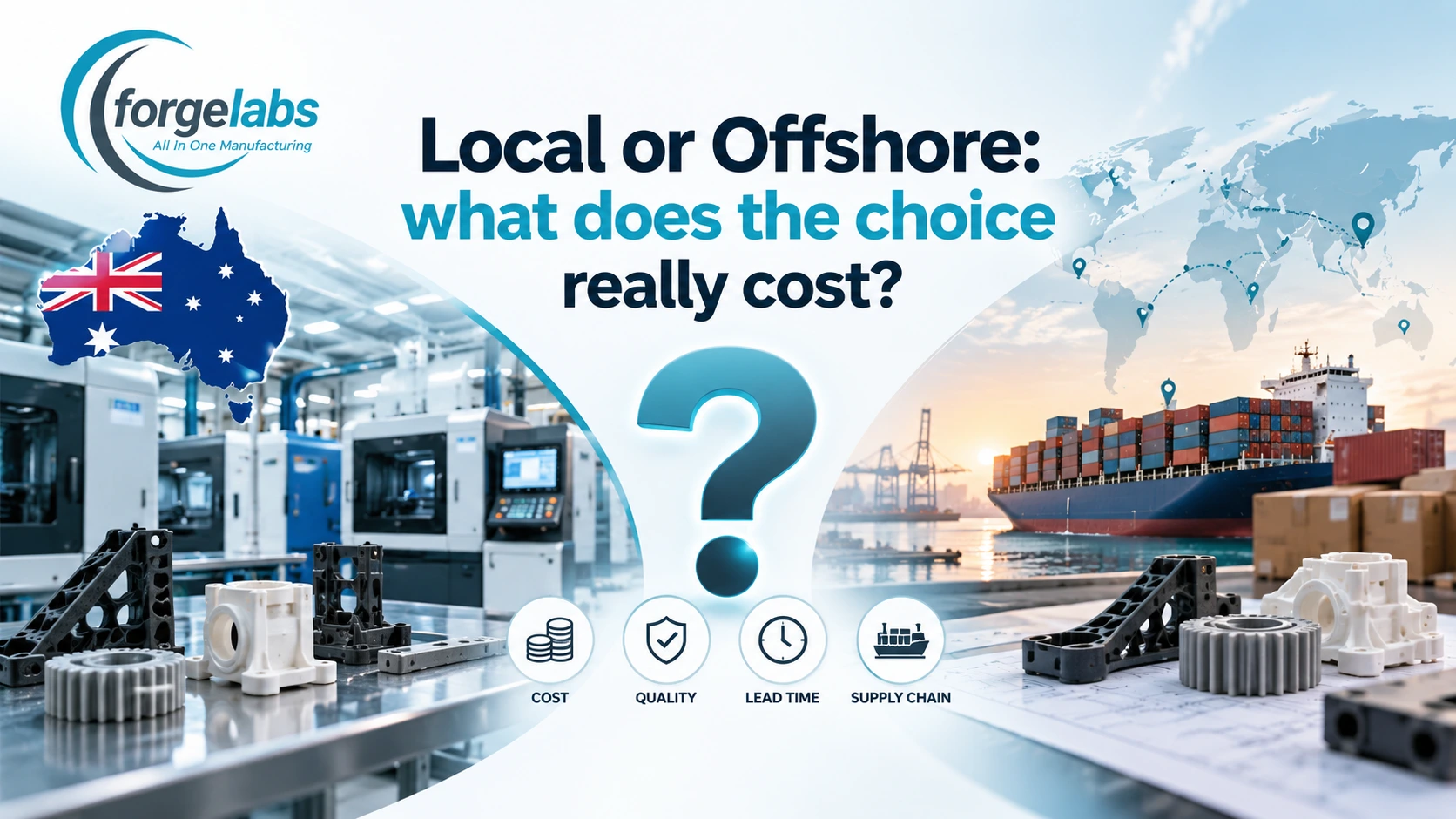
Offshore tooling often looks cheaper on the quote. Sometimes it is. But the invoice is only one line of the real cost.
Here is what the real cost includes:
- Freight and insurance to bring the tool to Australia.
- Customs duty on the tool.
- GST. The Australian Border Force says GST on imports is 10% of the customs value plus any duty, freight and insurance. The ATO explains that a GST registered business may be able to claim it back as a credit, so for many buyers it hits cash flow more than profit. Check your own position with your accountant.
- Inspection, design changes and the weeks a tool spends on a ship.
The Australian Border Force guide to GST and other taxes on imports also explains the deferral scheme, and a licensed customs broker can price your exact tool.
Many Australian moulders already blend both options. Supaflow and SDI say they build tools locally and through overseas partners, and Metplas says it offers in house or outsourced toolmaking. So the real question is often who manages the risk, not where the steel gets cut.
The non export tooling trap
Not every offshore tool is a bad tool. A Brisbane toolmaker, Dienamics, explains the difference between export tooling and non export tooling. Keep in mind that Dienamics sells local tooling, so read it with that in mind.
Its warning is worth knowing: a non export tool stays in its country of origin, and the quote may state a set number of shots. After that, the offshore maker can scrap the tool. You may not own it, and you may be unable to move it to another moulder.
Before you sign, ask in writing: Is this an export tool or a non export tool? Who owns it? How many shots is it built for? Can I move it to another moulder?
Questions to ask before you sign with any moulder
- Do you build the tool in house, or buy it in?
- Who owns the tool when it is paid for?
- Which steel or aluminium grade will you use, and why?
- Will glass filled plastic wear this tool faster?
- How many shots should the tool last?
- Will you send the first sample parts for my approval before production?
- What happens when the tool needs repair? Who pays, and how long does it take?
- Where will you store my tool, and is it insured?
- What is your minimum order?
- Which quality certificates do you hold, and can I see them?
If a supplier dodges any of these, treat that as your answer.
Which supplier fits your volume?
This is a rough guide, and every part is different.
- A handful of parts. Skip tooling. Use 3D printing prototypes, CNC machining or vacuum casting.
- Hundreds to a few thousand parts. Look for a moulder that offers aluminium tools. This is where many startups land.
- Tens of thousands of parts or more. A hardened steel tool starts to pay off, and a multi cavity design helps.
- Very high volume. Choose a large moulder with many machines and automation.
Not sure where you sit? Our guide to 3D printing vs CNC machining shows how to choose between those two processes, and our guide to choosing a prototype manufacturer covers the step before tooling.
What to send when you ask for a quote
Suppliers quote faster and more accurately when you send:
- A 3D file in STEP format, plus a 2D drawing if you have one
- The material you want, or what the part must do
- How many parts you need, and how often
- Colour, texture and surface finish
- Any parts that must fit together
- Your target price per part, if you have one
- Your deadline
If your design is confidential, get a signed agreement first. IP Australia's guide to non disclosure agreements lists manufacturers among the people you should protect yourself with before sharing a design.
Frequently asked questions
What is the difference between a moulder and a mould maker?
A mould maker builds the tool. A moulder runs the machine that makes the parts. Some companies do both.
How long does it take to build an injection mould?
It depends on size and detail. At Forge Labs, aluminium tools take 3 to 5 weeks and steel tools take 6 to 10 weeks. Ask every supplier for a written timeline and what could delay it.
How much does an injection mould cost in Australia?
Prices swing widely based on size, cavities, steel and finish. At Forge Labs, simple aluminium tools for small parts start from about AUD 3,000, and hardened steel tools for cosmetic consumer parts commonly run from AUD 10,000 to AUD 40,000, with multi cavity tools costing more. Get two or three quotes on the same drawing.
Is it cheaper to make moulds overseas?
The quote is often lower, but freight, duty, GST, inspection and delays add up. Watch for non export tooling, and compare the total cost, not only the invoice.
What is the minimum order for plastic injection moulding?
It varies by supplier. Some focus on large runs, and others take smaller batches. Ask before you design the tool.
Do I need an ISO certificate?
Not always, but it helps for medical, automotive and food parts. Ask to see the certificate rather than relying on a logo.
Can I move my mould to a different moulder?
Usually yes, if you own the tool. Confirm ownership in writing before you pay.
Ready to talk about your part?
Send us your file or a quick description. We will tell you whether moulding, 3D printing or machining fits best, and we will say so honestly if another supplier suits you better.