

Introduction:
“Up to 30% of additive manufacturing builds fail or require rework due to design errors, support issues, or process instability”, a statistic often cited across industry analyses. Yet most cost discussions around 3D printing ignore this entirely.
“3D printing isn’t cheap, it’s calculated. And that’s exactly where most businesses get it wrong.”
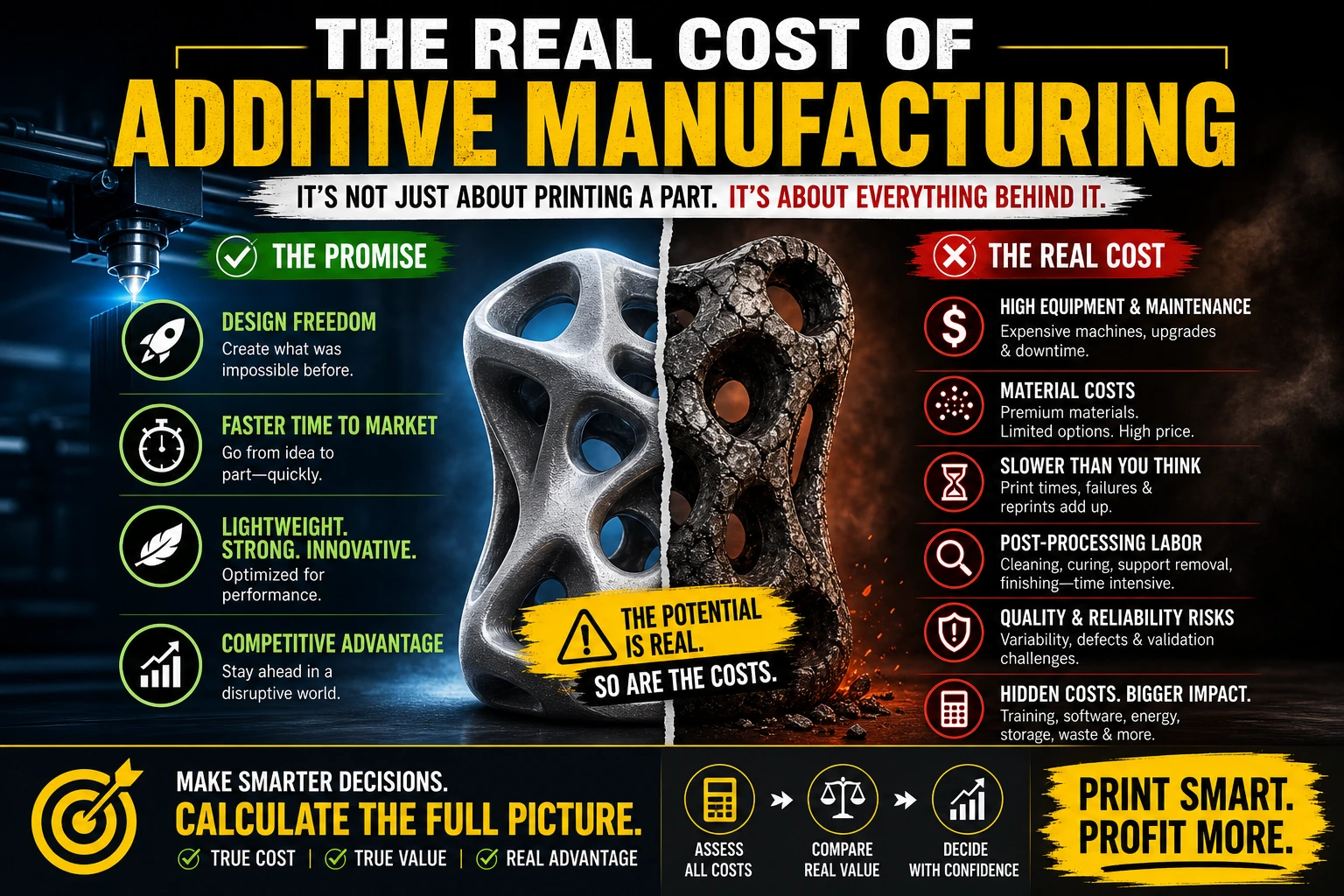
For years, the narrative has been overly simplified: additive manufacturing is ideal for low volumes and too expensive for mass production. While that holds some truth, it misses the deeper reality. The real cost of additive manufacturing isn’t defined by price per part—it’s shaped by variables like failure rates, design complexity, machine utilization, and post-processing requirements.
According to Wohlers Terry, one of the most cited voices in the industry, “the true value of additive manufacturing lies not just in production, but in design freedom and supply chain transformation.” In other words, focusing only on unit cost is a flawed way to evaluate its impact.
Unlike manufacturing, where tooling and setup take a lot of money at the start additive manufacturing spreads the cost over the whole process. From designing to final production. This changes how businesses think about growing, risk and getting a return on investment. A part that looks pricey on paper can often be the affordable option when you consider shorter lead times, no tooling and quicker design changes.
The question is, are you measuring the cost of 3D printing ? It's not about whether 3D printing's cheap or expensive. You need to think about printing costs, in a different way.
What Does “Cost” Really Mean in Additive Manufacturing?
Most businesses approach additive manufacturing cost the wrong way, by focusing only on visible expenses like material or machine time. In reality, the total cost of 3D printing is multi-layered, dynamic, and heavily influenced by operational variables that are often ignored.
To accurately evaluate the real cost of additive manufacturing, you need to shift from a “price per part” mindset to a system-level cost model.
Direct Costs vs Hidden Costs in Additive Manufacturing
At a surface level, 3D printing cost breakdown is divided into two categories:
Direct Costs (Visible & Measurable)
These are the costs most 3D printing services pricing models highlight:
-
Material costs (filament, resin, powder, metal)
-
Machine usage cost (hourly depreciation, runtime)
-
Labor cost (design prep, machine setup, post-processing)
These form the baseline for calculating 3D printing cost per part.
Hidden Costs (Ignored but Critical)
This is where most businesses lose money and where competitors fail to go deep.
-
Print failure rates (5–30%) → wasted material + machine time
-
Machine downtime (10–20%) → reduced throughput
-
Energy consumption → especially high in industrial systems
-
Software licensing → CAD, slicing, simulation tools
-
Maintenance & calibration → recurring operational overhead
-
Post-processing inefficiencies → sanding, curing, finishing
Insight:
Ignoring these factors leads to underestimated additive manufacturing cost per part, especially in production environments.
CapEx vs OpEx in Additive Manufacturing
A critical but often misunderstood concept in industrial 3D printing cost analysis.
CapEx (Capital Expenditure)
-
Buying machines (FDM, SLA, SLS, DMLS systems)
-
Infrastructure setup (ventilation, space, power requirements)
OpEx (Operational Expenditure)
-
Outsourcing to 3D printing service providers
-
Pay-per-part or pay-per-hour pricing models
-
Material + labor bundled costs
Reality most blogs miss:
While CapEx seems expensive upfront, OpEx can become significantly higher at scale, especially with repeated outsourcing.
Strategic insight:
-
Low volume → OpEx (outsourcing) makes sense
-
Scaling production → CapEx often becomes more cost-efficient
Cost Per Part vs Cost Per Iteration
This is one of the biggest conceptual gaps in competitor content—and your opportunity to dominate.
Traditional Manufacturing Model
-
Focus: cost per unit
-
Optimized for mass production
-
Tooling cost spread across large volumes
Additive Manufacturing Model
-
Focus: cost per iteration
-
Optimized for design flexibility and speed
-
No tooling → faster design cycles
Why this matters:
In product development, reducing iteration time can save weeks or months—making a higher per-part cost irrelevant.
Example:
-
CNC prototype: ₹10,000 + 2 weeks lead time
-
3D printed prototype: ₹2,000 + 2 days
Even if per-part cost is higher later, time-to-market savings create massive ROI.
Direct Costs of Additive Manufacturing
A deeper additive manufacturing cost breakdown reveals three primary cost drivers:
Material Costs in 3D Printing
Material selection directly impacts 3D printing cost per gram and final part pricing.
|
Material Type |
Cost Range (India) |
|
FDM Filament |
₹1–₹5 per gram |
|
SLA Resin |
₹5–₹15 per gram |
|
SLS Nylon Powder |
₹8–₹20 per gram |
|
Metal Powder |
₹50–₹500+ per gram |
Hidden Material Cost Factors:
-
Support structures → increase usage by 10–40%
-
Infill density → directly impacts weight & cost
-
Failed prints → 100% material loss
Advanced insight (gap):
Most blogs ignore material refresh rates in SLS, where unused powder degrades and must be partially replaced, raising real costs.
Machine Costs in Additive Manufacturing
Machine cost is calculated through depreciation per hour, not just purchase price.
|
Machine Type |
Cost Range |
Depreciation/Hour |
|
Desktop FDM |
₹20,000 – ₹2L |
₹20–₹50 |
|
SLA |
₹3L – ₹10L |
₹100–₹300 |
|
SLS |
₹50L – ₹2Cr |
₹800–₹2000 |
|
Metal (DMLS) |
₹3Cr – ₹10Cr |
₹3000–₹8000 |
Hidden Machine Cost Factors:
-
Idle machine time
-
Calibration losses
-
Build failures consuming full machine cycles
Labor Costs in 3D Printing
Labor is one of the most underestimated components in 3D printing service pricing.
Pre-Processing Costs:
-
CAD design & repair
-
Slicing & orientation
-
Support generation
Cost: ₹200–₹1000 per job
Post-Processing Costs:
-
Support removal
-
Sanding, polishing, curing
-
Surface finishing
Cost: ₹300–₹2000 per part
Gap to exploit:
Competitors rarely break down labor per stage—this adds authority to your content.
Hidden Costs Most Businesses Ignore
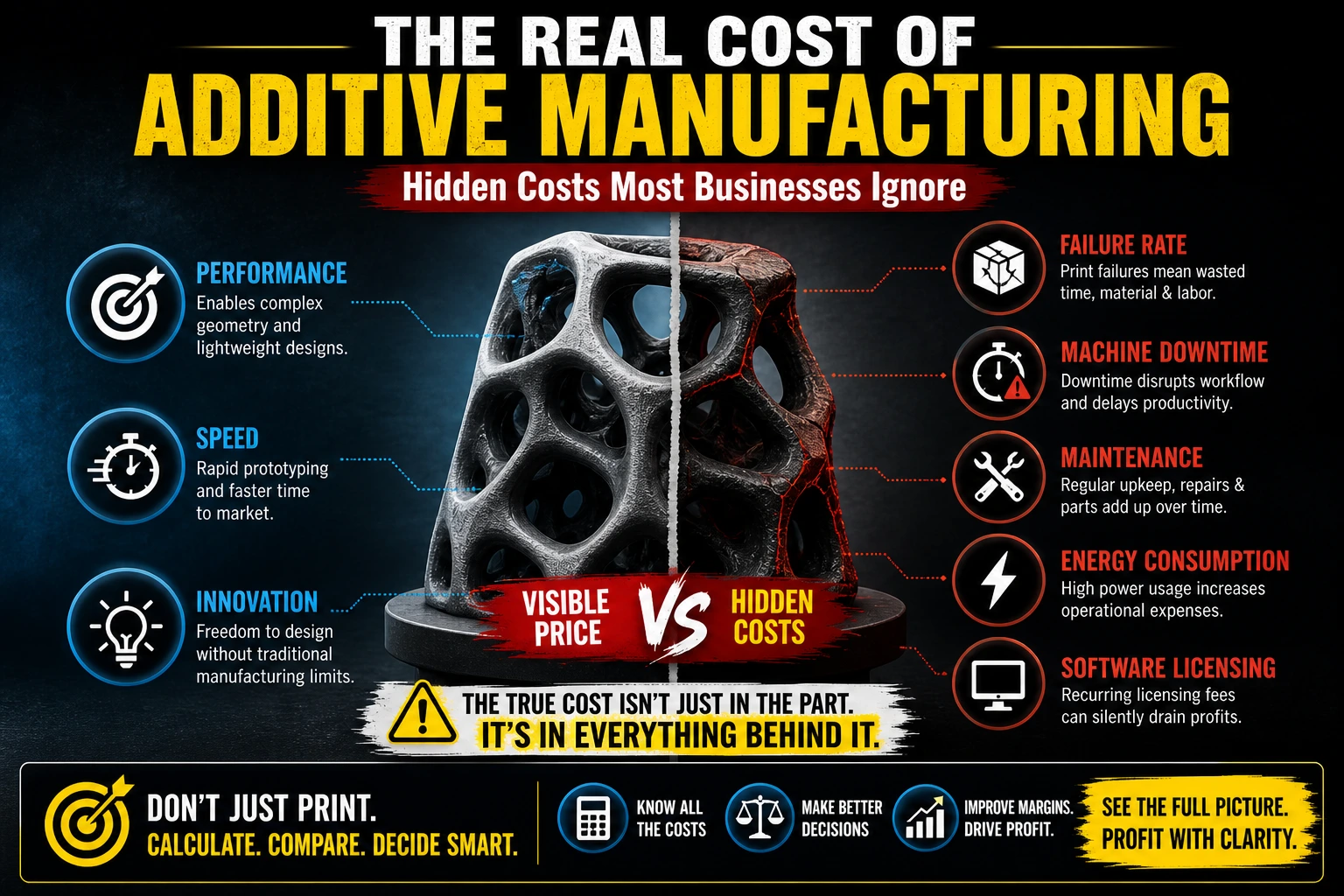
This is where your content will outperform competitors.
These costs define the true additive manufacturing cost per part.
Key Hidden Costs:
-
Failure Rate: 5–30%
-
Machine Downtime: 10–20% productivity loss
-
Maintenance: 5–10% of machine cost annually
-
Energy Consumption: ₹50–₹500 per build
-
Software Licensing: ₹50,000–₹5L/year
Example: Failure Cost per Batch (Critical Insight)
Let’s quantify what most competitors don’t:
-
Planned production: 100 parts
-
Base cost per part: ₹200
-
Failure rate: 20%
👉 Actual parts produced: 120
👉 Total cost: ₹24,000
👉 Usable parts: 100
Effective cost per usable part: ₹300
Cost Comparison: Additive vs Traditional Manufacturing
Low Volume (1–100 units)
✅ Winner: 3D Printing
-
No tooling cost
-
Fast turnaround
Medium Volume (100–10,000 units)
⚖️ Gray Zone
-
Depends on geometry & complexity
High Volume (10,000+ units)
❌ Winner: Injection Molding / CNC
-
Tooling cost gets distributed
-
Unit cost drops drastically
Break-even Insight:
3D printing dominates early—but traditional manufacturing wins at scale.
Cost Per Part: Real Examples
Example 1: Simple Plastic Part
-
Material: ₹50
-
Machine: ₹30
-
Labor: ₹70
👉 Total: ₹150–₹250
Example 2: Complex Industrial Part
-
Material: ₹500
-
Machine: ₹800
-
Labor: ₹700
👉 Total: ₹2000–₹4000
Example 3: Prototype vs Production
-
Prototype: High cost (iteration-heavy)
-
Production: Lower cost per unit (optimized batch)
Cost of Different 3D Printing Technologies
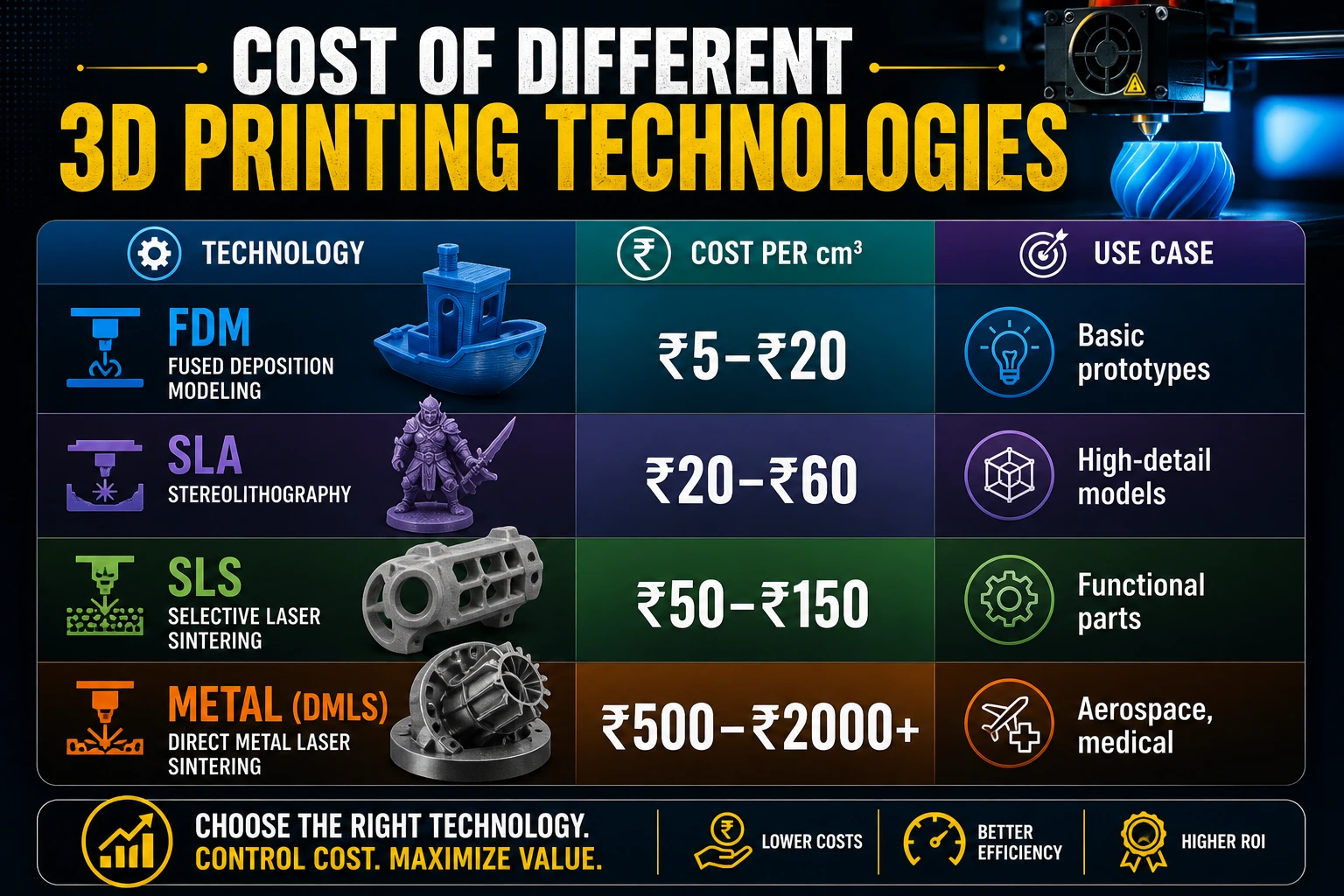
|
Technology |
Cost per cm³ |
Use Case |
|
₹5–₹20 |
Basic prototypes |
|
|
SLA |
₹20–₹60 |
High-detail models |
|
SLS |
₹50–₹150 |
Functional parts |
|
Metal (DMLS) |
₹500–₹2000+ |
Aerospace, medical |
When Additive Manufacturing is Actually Cost-Effective
3D printing delivers strong ROI when:
-
Rapid Prototyping: Faster iterations = lower development cost
-
Customization: No tooling needed
-
Complex Geometry: Impossible with traditional methods
-
On-Demand Production: Zero inventory cost
This is where additive manufacturing cost advantages shine.
When It Becomes Expensive
Let’s be honest, 3D printing isn’t always the right choice.
Avoid it when:
-
Producing mass volumes
-
Requiring tight tolerances + finishing
-
Printing large parts
-
Using expensive materials
This is why many businesses overpay—they use AM where it doesn’t fit.
Real ROI of Additive Manufacturing
Cost alone is misleading. ROI tells the real story.
Key ROI Drivers:
-
Reduced Time-to-Market
-
Lower Inventory Costs
-
Design Flexibility
-
Fewer Assembly Parts
A ₹2000 printed part might replace a ₹800 part—but eliminate ₹5000 in assembly and logistics.
Cost Optimization Strategies
High-impact ways to reduce 3D printing cost per part:
-
Design for Additive Manufacturing (DfAM)
-
Optimize orientation (reduces supports)
-
Batch printing
-
Choose the right material
-
Reduce over-engineering
Small design decisions can cut costs by 30–60%.
Additive Manufacturing Cost Statistics Table
|
Metric |
Typical Range |
Impact on Cost |
Insight |
|
Failure Rate |
5% – 30% |
High |
Directly increases cost per usable part |
|
Support Material Usage |
10% – 40% |
Medium–High |
Depends on design & orientation |
|
Machine Downtime |
10% – 20% |
High |
Reduces production efficiency |
|
Post-Processing Cost Share |
20% – 60% of total cost |
Very High |
Often exceeds printing cost |
|
Material Waste (SLS Powder Refresh) |
20% – 50% |
Medium |
Unused powder degrades over time |
|
Energy Consumption per Build |
₹50 – ₹500 |
Low–Medium |
Higher for industrial systems |
|
Labor Cost Contribution |
15% – 40% |
High |
Includes pre + post processing |
|
Maintenance Cost (Annual) |
5% – 10% of machine cost |
Medium |
Critical for industrial machines |
|
Software Cost (Annual) |
₹50,000 – ₹5,00,000 |
Medium |
CAD, slicing, simulation tools |
|
Build Success Rate (Optimized Workflow) |
85% – 95% |
Positive Impact |
Higher success = lower real cost |
|
Lead Time Reduction vs Traditional |
50% – 90% faster |
Strategic |
Impacts ROI more than cost |
|
Inventory Cost Reduction |
20% – 60% |
Strategic |
Enables on-demand manufacturing |
Additive Manufacturing Cost Optimization Checklist
Use this as a decision-making framework
|
Category |
Checklist Item |
Why It Matters |
|
Design Optimization |
Apply Design for Additive Manufacturing (DfAM) |
Reduces material and support usage |
|
Minimize support structures |
Cuts material cost by 10–40% |
|
|
Optimize part orientation |
Reduces failures and improves surface quality |
|
|
Material Selection |
Choose cost-effective material |
Impacts cost per gram directly |
|
Match material to application (avoid overengineering) |
Prevents unnecessary cost increase |
|
|
Production Strategy |
Batch multiple parts in one build |
Improves machine utilization |
|
Optimize build volume usage |
Reduces cost per part |
|
|
Machine Efficiency |
Monitor machine utilization rate |
Idle time increases cost |
|
Schedule preventive maintenance |
Avoids costly downtime |
|
|
Failure Reduction |
Validate designs before printing |
Reduces failure rate (5–30%) |
|
Use simulation tools |
Predicts warping, stress, defects |
|
|
Post-Processing |
Minimize finishing requirements |
Reduces labor cost |
|
Standardize workflows |
Improves consistency and speed |
|
|
Cost Modeling |
Calculate true cost per part (include hidden costs) |
Prevents underpricing |
|
Track cost per iteration |
Critical for product development |
|
|
Outsourcing vs In-house |
Evaluate CapEx vs OpEx |
Impacts long-term cost efficiency |
|
Compare service pricing vs internal cost |
Helps scale efficiently |
Pricing Models in 3D Printing Services
Service providers typically charge:
-
Per gram
-
Per hour of machine time
-
Per part
-
Value-based pricing (most expensive)
How Clients Get Overcharged:
-
Ignoring failure rates
-
Paying for inefficient orientation
-
Over-specifying materials
Understanding pricing helps control 3D printing service cost.
Future Trends: Will Costs Go Down?
Yes, but selectively.
What’s driving costs down:
-
Automation
-
Better materials
-
AI-driven print optimization
What will remain expensive:
-
Metal printing
-
High-precision industrial applications
FAQ’s
1. What is the real cost of additive manufacturing and how is it calculated?
The real cost of additive manufacturing includes material cost, machine cost per hour, labor, post-processing, failure rates, and hidden operational expenses. A complete additive manufacturing cost breakdown goes beyond price per part and considers the total lifecycle cost.
2. How much does 3D printing cost per part?
3D printing cost per part can range from ₹50 to ₹10,000+ depending on material, technology (FDM, SLA, SLS, metal), size, and complexity. Industrial 3D printing cost per part is higher due to precision and post-processing requirements.
3. What are the main cost factors in additive manufacturing?
Key additive manufacturing cost factors include material cost, machine depreciation, labor, energy consumption, software, failure rate, and post-processing. These directly impact the total cost of 3D printing.
4. Is 3D printing cheaper than traditional manufacturing?
3D printing vs traditional manufacturing cost depends on volume. For low-volume production and prototyping, additive manufacturing is more cost-effective. For high-volume production, injection molding or CNC machining is usually cheaper.
5. What are the hidden costs of 3D printing?
Hidden costs of 3D printing include failed prints, machine downtime, maintenance, software licensing, energy usage, and support material waste. These can increase the actual 3D printing cost per part by 20–50%.
6. What is the cost per gram in 3D printing materials?
3D printing material cost varies: FDM filament ₹1–₹5/gram, SLA resin ₹5–₹15/gram, SLS nylon ₹8–₹20/gram, and metal powders ₹50–₹500+/gram. This directly affects additive manufacturing cost per part.
7. How does additive manufacturing cost compare to injection molding?
Additive manufacturing vs injection molding cost shows that 3D printing is cheaper for low volumes and complex designs, while injection molding becomes more cost-effective at scale due to lower cost per unit.
8. What is the cost of industrial 3D printing machines?
Industrial 3D printing machine cost ranges from ₹50 lakh to ₹10 crore depending on technology (SLS, DMLS, metal printing). Machine depreciation per hour significantly impacts overall additive manufacturing cost.
9. How can you reduce 3D printing cost?
To reduce 3D printing cost, optimize design for additive manufacturing (DfAM), minimize support structures, batch print parts, choose cost-effective materials, and reduce failure rates.
10. What is the ROI of additive manufacturing?
Additive manufacturing ROI comes from faster prototyping, reduced tooling cost, lower inventory, and shorter time-to-market. Even if the cost per part is higher, overall business savings make 3D printing cost-effective.
About the Author
Forge Labs is a leading provider of advanced additive manufacturing solutions, delivering high-precision, scalable, and production-ready outcomes for businesses across industries. The team at Forge Labs has a lot of experience with designing things in the way possible, picking the right materials and getting things made from start to finish. They help companies save money, get products made faster and make their manufacturing process better.
Forge Labs is good at helping clients from the beginning when they are just making a prototype, all the way to when they are making a lot of something. They use what they know about technology and what they have learned from working in the industry to help clients make decisions about manufacturing. They do not just make parts they also help businesses understand what additive manufacturing really costs, how to avoid mistakes and how to get the return on their investment.
Recognized for delivering some of the best 3D printing services in Australia, Forge Labs supports engineers, manufacturers, and product teams with reliable, high-quality solutions tailored to real-world applications.
Whether it’s optimizing a single prototype or scaling complex production, Forge Labs is committed to making additive manufacturing more predictable, efficient, and strategically valuable.
Failure Rates (5–30%)
-
Source: SME and industry surveys summarized in the Wohlers Report
-
Insight: Build failures vary significantly based on technology and process maturity
Post-Processing Cost (20–60% of total cost)
-
Source: DyeMansion and EOS GmbH
-
Insight: Post-processing often exceeds printing cost in industrial workflows
Machine Downtime (10–20%)
-
Source: McKinsey & Company
-
Insight: Operational inefficiencies significantly affect additive manufacturing cost
Maintenance Cost (5–10% annually)
-
Source: Deloitte
-
Insight: Industrial equipment maintenance forms a consistent cost layer
Material Waste in SLS (20–50% refresh rate)
-
Source: 3D Systems and EOS GmbH
-
Insight: Powder degradation requires partial replacement, increasing cost
-
Link: https://www.eos.info/en/material-m
Conclusion
Additive manufacturing was never meant to be the option. It actually wins because it offers control.
The real cost of manufacturing isn't just one number. It's a combination of factors: design freedom, how fast you can make changes, how often things go wrong, how much you use your machines and how it affects your supply chain. If you only look at the price per part you miss out on the picture. When you consider the cost of the product lifecycle the numbers start to look different.
3D printing is really good at delivering value in areas where traditional methods have trouble. These areas include dealing with uncertainty, handling complexity and moving fast. It helps businesses switch from reacting to problems during production to making smart decisions ahead of time.
It allows businesses to move from production to proactive decision-making, with additive manufacturing and 3D printing. Additive. 3D printing delivers value.
-
You don’t just reduce cost, you reduce risk
-
You don’t just produce parts, you accelerate innovation cycles
-
You don’t just manufacture, you gain operational flexibility
The companies that benefit the most aren’t the ones chasing the lowest unit cost. They’re the ones optimizing for:
-
Predictability (knowing true costs upfront)
-
Flexibility (adapting designs without penalties)
-
Strategic efficiency (aligning production with business goals)
In that sense, additive manufacturing isn’t an expense, it’s a competitive lever.
For more information you can contact us.