

Summary
3D printing in 2026 is shifting from basic prototyping to real-world production, driven mainly by advanced materials. Traditional options like PLA and ABS are no longer enough for industries that need strength, heat resistance, and durability. Materials such as carbon fiber reinforced polymers, high-performance thermoplastics like PEEK, metal powders like titanium, sustainable materials, and conductive smart materials are leading this change.
These materials allow companies to create lighter, stronger, and more functional parts across aerospace, medical, automotive, and manufacturing sectors. However, choosing the right material depends on the application, cost, and performance needs. Businesses that understand material selection can reduce costs, improve product quality, and gain a strong competitive advantage in modern manufacturing.
Key Takeaways
-
3D printing materials are now more important than the machines themselves
-
Carbon fiber materials offer high strength with reduced weight
-
PEEK and PEKK are ideal for high-temperature and demanding environments
-
Metal 3D printing enables complex, high-performance parts
-
Sustainable materials are growing due to environmental demand
-
Smart and conductive materials are shaping future innovations
-
Material selection directly impacts cost, durability, and performance
-
Advanced materials are moving from prototyping to full-scale production
-
Industries like aerospace and healthcare are leading adoption
-
Choosing the right material gives a strong competitive advantage
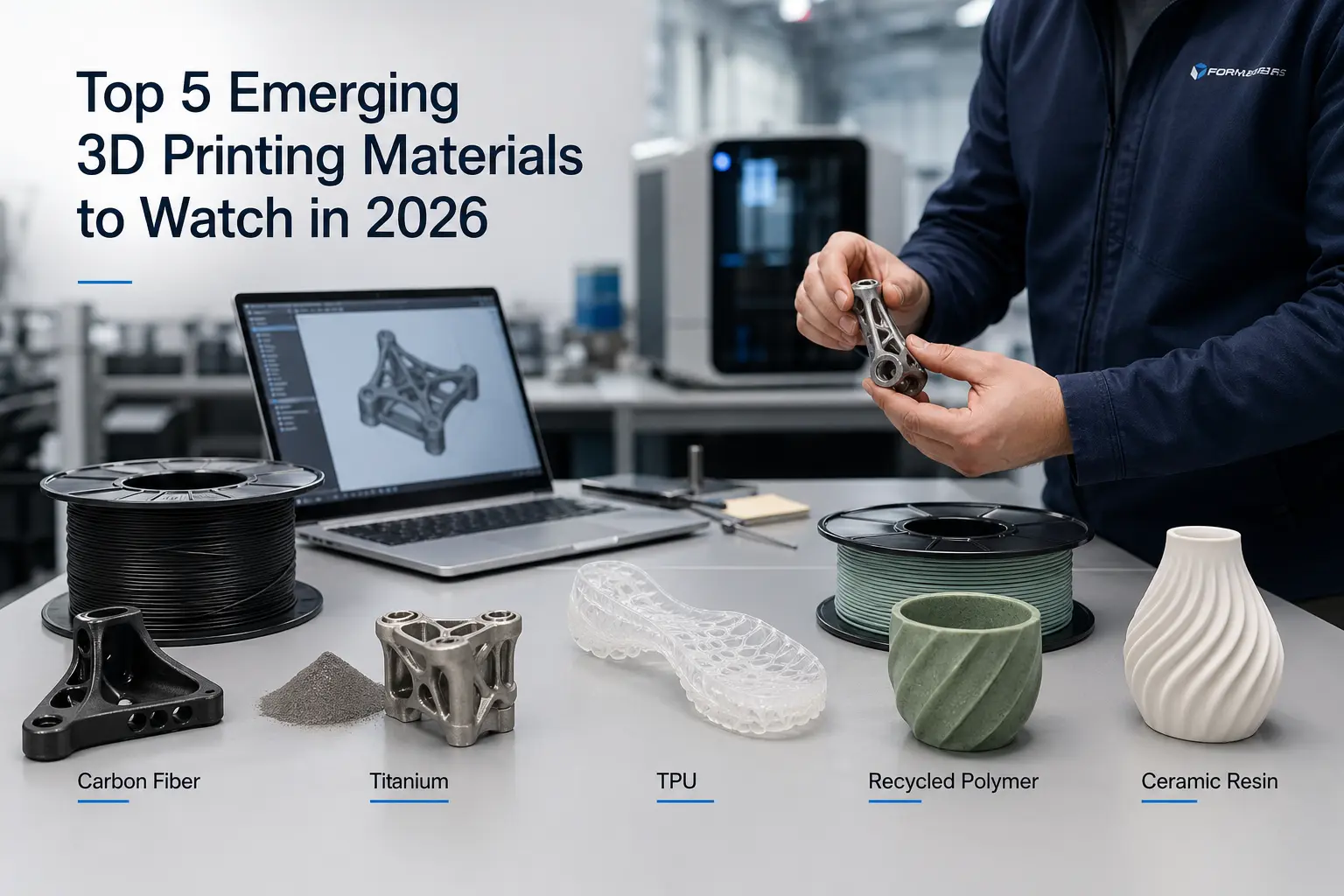
Top 5 Emerging 3D Printing Materials to Watch in 2026
3D printing has reached a turning point. According to industry reports, more than 60 percent of manufacturers now use additive manufacturing beyond prototyping, moving into real production. At the same time, material innovation is growing faster than hardware. This shift is changing how products are designed, tested, and manufactured across industries.
The limitation is no longer the printer. It is the material.
For years, PLA and ABS defined what was possible. Today, they are no longer enough. Aerospace demands lighter parts with extreme strength. Medical applications require biocompatible and sterilizable materials. Automotive and robotics need components that can handle heat, stress, and long-term wear. At the same time, global pressure for sustainability is pushing companies toward eco-friendly alternatives.
As Terry Wohlers, a leading expert in additive manufacturing and principal at Wohlers Associates, has pointed out, the real growth in 3D printing is now being driven by advanced materials, not machines. In simple terms, better materials are unlocking better products.
The top emerging 3D printing materials in 2026 are important now. These 3D printing materials are not just ideas, they are actually being used to make things in the world. This is affecting how companies decide what to buy, how to save money and how to work better.
In this guide you will find out which 3D printing materials are becoming popular why industries are putting money into them and how to pick the 3D printing material for what you need. If you want to keep up with companies that make things you need to know about these 3D printing materials. Knowing about these printing materials is no longer something you can choose to do it is something you have to do.
For a quick snapshot of where the market is heading, this recent video is worth watching: https://www.youtube.com/watch?v=OVv_T-_JaGY
What is changing in 3D printing materials right now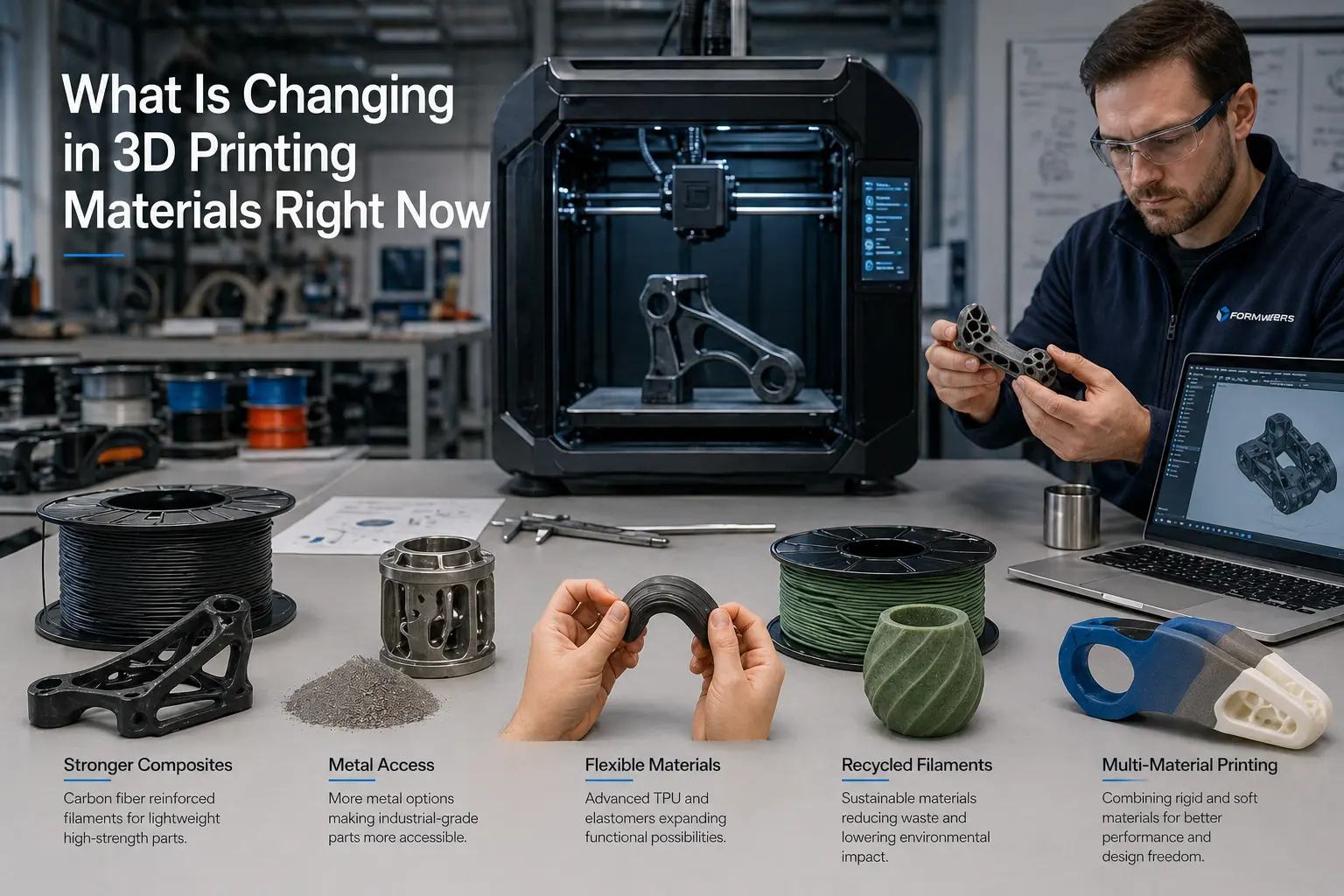
The short answer is simple: materials are getting more useful for real parts, not just mockups. In 2026, buyers care less about flashy new names and more about whether a part survives heat, load, wear, and daily use.
That shift matters if you are tracking the Top 5 Emerging 3D Printing Materials to Watch in 2026. New composites, high-heat polymers, and better flexible materials are giving shops more options, but they also raise the bar for material selection. A strong shop like Forge Labs stands out here because material choice, machine control, and part design have to work together, or the print fails where it counts.
The features that matter most in 2026
When you compare 3D printing materials today, start with the job the part must do. A pretty sample is easy. A part that holds weight, faces heat, and lasts in service is harder.
This quick table shows the factors that matter most when choosing modern 3D printing materials.
|
Feature |
What it tells you |
Why it matters in real use |
|
Strength |
How much force the part can take before it breaks |
Good for brackets, mounts, tools, and load-bearing parts |
|
Stiffness |
How much the part bends under force |
Important for jigs, frames, and parts that must stay accurate |
|
Temperature resistance |
How well the part holds shape under heat |
Needed near engines, lights, hot air, or warm enclosures |
|
Chemical resistance |
How well it handles oils, cleaners, fuels, or solvents |
Critical in industrial, medical, and automotive settings |
|
Print difficulty |
How hard it is to print without warping or failure |
Affects scrap rate, repeatability, and lead time |
|
Cost |
Material price and print cost together |
Helps you judge if the part makes business sense |
|
End-use fit |
Whether the material matches the actual application |
Stops costly mistakes from picking a material on specs alone |
A few of these points need extra care. Strength and stiffness are not the same thing. A part can resist breaking but still flex too much. That is why carbon-fiber-filled materials and glass-filled blends are getting attention. They help printed parts hold shape better, which matters for fixtures and structural pieces.
Heat also matters more than many buyers expect. Some newer high-performance polymers can handle temperatures above 200 C, which is why they are moving into aerospace and automotive work. If your part sits near a motor, heater, or sun-baked housing, heat resistance is not optional. A basic guide on FDM material selection and design rules explains this well, especially the trade-off between mechanical performance and printability.
Chemical resistance is another filter that saves money. Nylon may work well in one shop and fail in another if oils, cleaners, or moisture are part of daily use. In other words, a material that looks strong on paper can still be the wrong pick.
The best material is the one that survives the real job, not the one with the most impressive data sheet.
Printing can be really tough for a lot of teams. They have to deal with materials that need to be stored in a dry place and the printer needs to be hot and have a special room to work well. If the printer cannot keep everything it does not matter how good the material is supposed to be. That is why a lot of companies work with places, like Forge Labs to get things made.
They have the equipment to do a good job. Having equipment is not enough though.
When you are thinking about what material to use do not think about the cost first. A cheap material that breaks easily is actually very expensive. A material that costs a little more but helps reduce breakage makes things lighter. Saves time putting things together is usually the better choice.
Why more companies are testing advanced materials now
More companies are testing advanced 3D printing materials because the equipment is better, the process is more stable, and the parts now solve real production problems. That change is not hype. It is showing up in materials, machines, and buying behavior at the same time.
First, printers have improved. Better chamber control, stronger extruders, tighter thermal management, and smarter software make engineering materials easier to run. This matters because advanced polymers and composites are less forgiving than PLA or standard PETG. When print conditions stay stable, failure rates drop and repeatability improves.
Second, manufacturers want lighter custom parts. In aerospace, robotics, medical devices, and automotive work, every ounce and every design tweak matters. A printed part can combine shapes that would be slow or costly to the machine. When you pair that freedom with stronger materials, 3D printing becomes a production tool, not just a prototyping tool.
Market growth supports that trend. Recent market estimates show the 3D printing materials segment growing fast into 2026, while advanced polymers keep a large share because of their heat resistance, strength, and use in demanding jobs. The broader materials market is also expanding quickly, with one forecast pointing to major year-over-year growth in 2026 through this 3D printing materials market report.
Two material groups stand out right now:
-
Continuous fiber materials are moving beyond niche demos. They add serious stiffness and strength while keeping weight low. Research on carbon-fiber lattice structures shows why so many teams are paying attention to this category.
-
High-performance polymers such as PEEK, PEKK, PPS, and PEI are getting more real-world trials. They can handle heat, chemicals, and wear far better than common desktop materials.
That does not mean every company is ready to switch overnight. These materials still cost more, and they demand tighter print control. Yet the reasons to test them are stronger now because the payoff is clearer. A lighter bracket, a heat-safe enclosure, or a custom fixture that lasts six months longer can change a cost model fast.
For readers following the Top 5 Emerging 3D Printing Materials to Watch in 2026, this is the key point: advanced materials are no longer stuck in small lab runs. They are moving into quoting, pilot production, and field testing. Shops like Forge Labs are well placed to turn that shift into usable parts because they can match material choice to part geometry, printer capability, and end-use demands. That is where the real value is.
Quick Comparison of Emerging 3D Printing Materials
|
Material |
Key Benefit |
Industry Use |
Printing Technology |
Cost Level |
|
Carbon Fiber Reinforced Polymers |
High strength, lightweight |
Automotive, aerospace |
FDM, SLS |
Medium-High |
|
High-Performance Thermoplastics (PEEK, PEKK) |
Heat and chemical resistance |
Medical, aerospace |
FDM, SLS |
High |
|
Metal Powders (Titanium, Inconel) |
Extreme strength and durability |
Aerospace, industrial |
DMLS, SLM |
Very High |
|
Sustainable Materials |
Eco-friendly and recyclable |
Consumer products |
FDM |
Low-Medium |
|
Conductive & Smart Materials |
Electrical and responsive properties |
Electronics, IoT |
FDM, SLA |
Medium |
1. Carbon Fiber Reinforced Polymers (CFRP)
Carbon fiber 3D printing is becoming a standard choice for industries that need lightweight yet strong parts. These materials combine plastic with carbon fibers, which increases strength without adding weight.
Manufacturers use carbon fiber reinforced polymers in automotive and aerospace applications where weight reduction directly improves performance. In many cases, replacing metal parts with CFRP can reduce weight by up to 40 percent while maintaining structural strength.
Key advantages:
-
High strength-to-weight ratio
-
Excellent stiffness and rigidity
-
Ideal for functional prototypes and end-use parts
-
Reduces fuel consumption in automotive and aerospace applications
Limitations:
-
More expensive than standard filaments
-
Requires compatible industrial-grade printers
-
Can be abrasive and wear down printer nozzles
-
Limited flexibility compared to pure polymers
Best use cases:
Lightweight structural parts, jigs and fixtures, aerospace components, automotive brackets.
This makes CFRP one of the most important industrial 3D printing materials in 2026.
2. High-Performance Thermoplastics (PEEK, PEKK)
Materials like PEEK and PEKK are known for their extreme heat resistance and durability. Unlike standard plastics, they can handle temperatures above 250°C and resist chemicals, making them ideal for demanding environments.
These materials are widely used in aerospace, medical implants, and engineering applications. They are especially useful when parts must survive high stress and high temperature conditions.
Key advantages:
-
Exceptional heat resistance
-
High chemical and wear resistance
-
Strong mechanical performance under stress
-
Biocompatibility (useful in medical applications)
Limitations:
-
Very high material and printing cost
-
Requires specialized high-temperature 3D printers
-
Difficult to print and process
-
Limited accessibility for small businesses
Best use cases:
Aerospace parts, medical implants, oil and gas components, high-performance engineering parts.
High-performance 3D printing materials like PEEK offer long-term reliability, which makes them valuable for critical applications.
3. Metal 3D Printing Materials (Titanium, Inconel)
Metal 3D printing materials are really changing the way we make things. Metal 3D printing materials like Titanium and Inconel are used a lot because they are very strong and can resist corrosion for a long time.
Some industries, like aerospace and heavy manufacturing really need metal 3D printing to make parts. These are parts that're hard or even impossible to make using the old ways of doing things. Metal 3D printing is very important for these industries.
Key advantages:
-
Extremely high strength and durability
-
Excellent heat and corrosion resistance
-
Ability to produce complex geometries
-
Suitable for end-use production parts
Limitations:
-
Very high cost of materials and machines
-
Requires post-processing (heat treatment, finishing)
-
Slower production speed compared to plastics
-
Not suitable for low-cost or high-volume simple parts
Best use cases:
Aerospace components, medical implants, industrial tools, high-performance mechanical parts.
Metal 3D printing is best suited for high-value applications where performance matters more than cost.
4. Sustainable and Eco-Friendly Materials
Sustainability is becoming a major factor in material selection. Many companies now look for eco-friendly 3D printing materials that reduce environmental impact.
These include biodegradable filaments, recycled plastics, and newer materials made from algae or organic sources. These materials are ideal for consumer products, packaging, and low-impact manufacturing.
Key advantages:
-
Reduced environmental impact
-
Supports sustainable manufacturing goals
-
Increasing availability and variety
-
Positive brand perception for businesses
Limitations:
-
Lower strength compared to industrial materials
-
Limited use in high-load applications
-
Performance can vary depending on source material
-
Not always suitable for long-term durability
Best use cases:
Consumer goods, packaging prototypes, educational models, low-stress components.
While they may not yet match the strength of advanced materials, demand for sustainable 3D printing materials is growing fast due to regulations and customer expectations.
5. Conductive and Smart Materials
Conductive and smart materials are opening new possibilities in 3D printing. These materials can conduct electricity or respond to environmental changes, which makes them useful for electronics and IoT applications.
For example, conductive filament 3D printing allows manufacturers to create circuits directly inside printed parts. Smart materials can change shape or properties based on heat, pressure, or moisture.
Key advantages:
-
Enables embedded electronics in printed parts
-
Supports innovation in IoT and wearable devices
-
Reduces need for separate assembly
-
Opens door to 4D printing applications
Limitations:
-
Still in early development stages
-
Limited mechanical strength compared to standard materials
-
Higher cost than conventional filaments
-
Requires precise design and expertise
Best use cases:
Sensors, wearable devices, smart components, embedded circuits, research and innovation projects.
This category represents the future of advanced 3D printing materials, especially as industries move toward smarter and more connected products.
3D Printing Material Selection Checklist
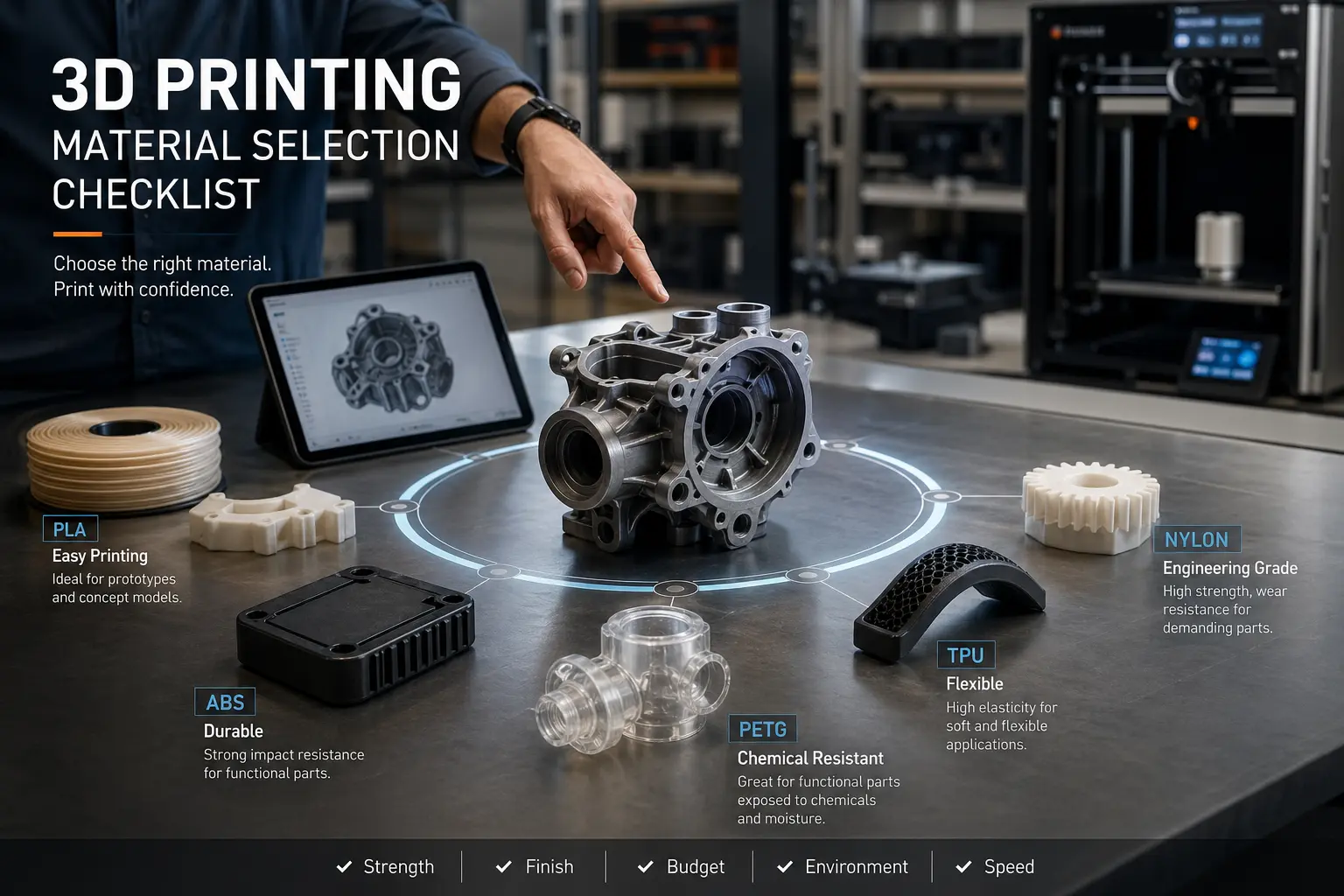
Use this checklist to help readers (and potential customers) quickly decide the right 3D printing material based on their needs. This also improves engagement and dwell time.
|
Criteria |
Yes/No |
Recommended Material Direction |
|
Do you need high strength and lightweight parts? |
Carbon Fiber Reinforced Polymers |
|
|
Will the part face high temperatures (above 200°C)? |
PEEK / PEKK (High-performance thermoplastics) |
|
|
Is maximum durability and metal-like performance required? |
Metal 3D Printing Materials (Titanium, Inconel) |
|
|
Is cost a major concern for your project? |
Standard or Sustainable Materials |
|
|
Do you need eco-friendly or recyclable materials? |
Sustainable 3D Printing Materials |
|
|
Will the part be used in electronics or IoT applications? |
Conductive / Smart Materials |
|
|
Do you need chemical resistance? |
High-performance thermoplastics |
|
|
Is the part for prototyping or end-use production? |
Prototype: standard/sustainable, Production: CFRP / Metal / PEEK |
|
|
Do you need complex geometry or internal structures? |
Metal or advanced polymers |
|
|
Do you require regulatory compliance (medical/aerospace)? |
PEEK, PEKK, Titanium |
Key Statistics on Emerging 3D Printing Materials
Adding statistics builds authority and trust, and helps your content rank better.
|
Metric |
Data Insight |
|
Adoption Rate |
Over 60% of manufacturers now use 3D printing beyond prototyping |
|
Material Growth |
Advanced 3D printing materials segment is growing faster than hardware |
|
Carbon Fiber Usage |
Up to 40% weight reduction compared to metal parts |
|
PEEK Market Demand |
Rapid growth due to aerospace and medical applications |
|
Metal 3D Printing |
One of the fastest-growing segments in industrial manufacturing |
|
Sustainability Trend |
Increasing demand due to ESG and environmental regulations |
|
Cost Factor |
Metal 3D printing can be 5–10x more expensive than polymer printing |
|
Industry Usage |
Aerospace, automotive, and healthcare lead adoption |
|
Production Shift |
More companies moving toward end-use part production |
|
Future Trend |
Rise of multi-material and smart material printing |
Real Industry Applications
Advanced 3D printing materials are already solving real problems across industries.
In aerospace, companies use carbon fiber and metal materials to reduce weight and improve fuel efficiency.
In healthcare, high-performance thermoplastics are used for implants and medical devices.
In manufacturing, metal 3D printing materials help produce complex parts faster and more efficiently.
In consumer products, sustainable materials support eco-friendly production.
These real-world applications show how material innovation is driving the future of additive manufacturing.
Challenges and Limitations
Even though these materials are powerful, they come with challenges.
High-performance materials like PEEK and metals are expensive.
Not all 3D printers support advanced materials.
Some materials require complex post-processing.
Sustainable materials may not yet match industrial strength.
Understanding these limitations helps you make better decisions and avoid costly mistakes.
Future of 3D Printing Materials
The future of printing materials is really looking good. We are going to see a lot more of this thing called -material printing, where you can use different materials to make one part. This means that engineers will be able to pick the material for the job a lot faster thanks to artificial intelligence that helps with material selection.
Smart materials and this new thing called 4D printing are going to keep getting better. This will allow things that are printed to change and react to what's happening around them. All of these developments are going to make 3D printing a lot more efficient and flexible and we will see it being used in many different industries, including 3D printing.
About the Author – Forge Labs
Forge Labs is a leading provider of 3D printing services in Australia, with over 15 years of hands-on experience in additive manufacturing, product development, and industrial prototyping. The team works closely with engineers, manufacturers, and businesses to turn complex ideas into functional, production-ready parts.
Forge Labs has a lot of knowledge about materials used in 3D printing like carbon fiber and special plastics. They also work with metal 3D printing. Forge Labs wants to give people solutions that really work, are reliable and do not cost much.
They do not just print things they also help people pick the material and way to make it so it works well in the real world.
Forge Labs has helped with projects in areas, like aerospace and cars, medical things and making stuff. This means they know what is happening now and can use ideas about materials to solve problems that really exist. Forge Labs knows about 3D printing and uses this to help people.
If you are looking for a trusted partner for advanced 3D printing services in Australia, Forge Labs brings both technical expertise and practical insight to every project.
Key Statistics on Emerging 3D Printing Materials (2026)
|
Category |
Statistic |
Insight for Readers |
|
Adoption of Additive Manufacturing |
60%+ of manufacturers now use 3D printing beyond prototyping |
Shows shift toward real production use |
|
Advanced Materials Growth |
Material segment growing faster than hardware (8–12% CAGR) |
Materials are driving industry innovation |
|
Carbon Fiber 3D Printing |
Up to 30–40% weight reduction vs metal parts |
Ideal for lightweight industrial applications |
|
High-Performance Polymers |
PEEK and PEKK demand growing rapidly in aerospace and medical sectors |
Driven by heat resistance and durability needs |
|
Metal 3D Printing Market |
Expected to cross $15–20 billion globally by 2026 |
Strong growth in industrial manufacturing |
|
Cost Comparison |
Metal 3D printing can be 5–10x more expensive than polymer printing |
Important for decision-making and budgeting |
|
Sustainability Demand |
70%+ companies prioritizing sustainable materials |
ESG and regulations driving adoption |
|
Industrial Usage |
Aerospace, automotive, and healthcare are top adopters |
High-performance industries lead innovation |
|
Production Shift |
Increasing use for end-use parts, not just prototypes |
Signals maturity of additive manufacturing |
|
Smart Materials Growth |
Rapid rise in conductive and 4D printing materials |
Future-focused innovation area |
|
Multi-Material Printing |
Growing adoption in advanced manufacturing setups |
Enables complex and functional parts |
|
Failure Rate Reduction |
Improved printers reduce failure rates by up to 25–40% |
Better reliability for advanced materials |
|
ROI Impact |
Companies report 20–50% cost savings in specific applications |
Especially in tooling and lightweight parts |
|
Lead Time Reduction |
3D printing can reduce production time by up to 70% |
Faster product development cycles |
|
Customization Demand |
Mass customization demand increasing across industries |
Key advantage of additive manufacturing |
FAQs
1. What are the most advanced 3D printing materials in 2026?
The most advanced 3D printing materials in 2026 include carbon fiber reinforced polymers, high-performance thermoplastics like PEEK and PEKK, metal 3D printing materials such as titanium and Inconel, sustainable 3D printing materials, and conductive or smart materials used in advanced applications.
2. Which 3D printing material is best for industrial use?
The best 3D printing materials for industrial use are carbon fiber reinforced polymers for lightweight strength, metal 3D printing materials for durability, and high-performance thermoplastics for heat and chemical resistance.
3. What is the strongest 3D printing material available today?
Metal 3D printing materials like titanium are the strongest, followed by carbon fiber reinforced polymers. These materials offer high tensile strength and are widely used in aerospace and manufacturing.
4. What are high-performance 3D printing materials used for?
High-performance 3D printing materials such as PEEK and PEKK are used in aerospace, medical devices, and engineering applications where heat resistance, chemical stability, and mechanical strength are critical.
5. Are sustainable 3D printing materials reliable for production?
Sustainable and eco-friendly 3D printing materials are reliable for many applications, especially consumer products and packaging. However, they may not yet replace industrial-grade materials in high-load environments.
6. What is the cost of metal 3D printing materials?
The cost of metal 3D printing materials is high compared to standard plastics. It depends on the material type, such as titanium or Inconel, and also includes machine cost and post-processing, making it suitable for high-value applications.
7. What are conductive 3D printing materials used for?
Conductive 3D printing materials are used to create electronic components, circuits, sensors, and IoT devices. They allow manufacturers to integrate electrical functionality directly into printed parts.
8. How do I choose the right 3D printing material for my project?
To choose the right 3D printing material, consider strength, temperature resistance, cost, application type, and required durability. Industrial applications often require advanced materials, while prototypes may use standard filaments.
9. What are the best 3D printing materials for manufacturing and production?
The best materials for manufacturing include carbon fiber reinforced polymers, metal 3D printing materials, and high-performance thermoplastics because they provide durability, precision, and long-term performance.
10. What is the future of 3D printing materials?
The future of 3D printing materials includes smart materials, multi-material printing, AI-driven material selection, and more sustainable solutions that improve efficiency and reduce environmental impact.
Conclusion
3D printing is no longer limited by machines. It is defined by materials. The real competitive advantage in 2026 comes from choosing the right material for the right application.
Carbon fiber is really helping companies make things lighter without losing any strength. Some special plastics like PEEK are very good at handling tough conditions. The materials used for 3D printing with metal are making it possible to create valuable things that could not be made before. At the time the materials used for sustainable 3D printing are helping companies to make things in a way that is better for the earth and special materials that can conduct electricity are making new things possible in the world of electronics and innovation.
This change is affecting how products are designed and tested and made. Companies that understand these materials for 3D printing can work faster and save money and make products that work better. Carbon fiber and 3D printing materials, like PEEK and metal are giving companies an advantage. Companies that do not pay attention to this change will have a time competing with companies that use carbon fiber and 3D printing materials.
The key is not just knowing these materials exist. The key is knowing when and how to use them. A wrong material choice can increase costs and reduce performance. A correct choice can transform your entire production process.
If you are serious about using 3D printing for manufacturing, prototyping, or product development, your material strategy must come first. The future of additive manufacturing belongs to businesses that combine the right technology with the right materials.
Now is the time to move beyond basic plastics and start using materials that actually solve real-world problems.