

Summary
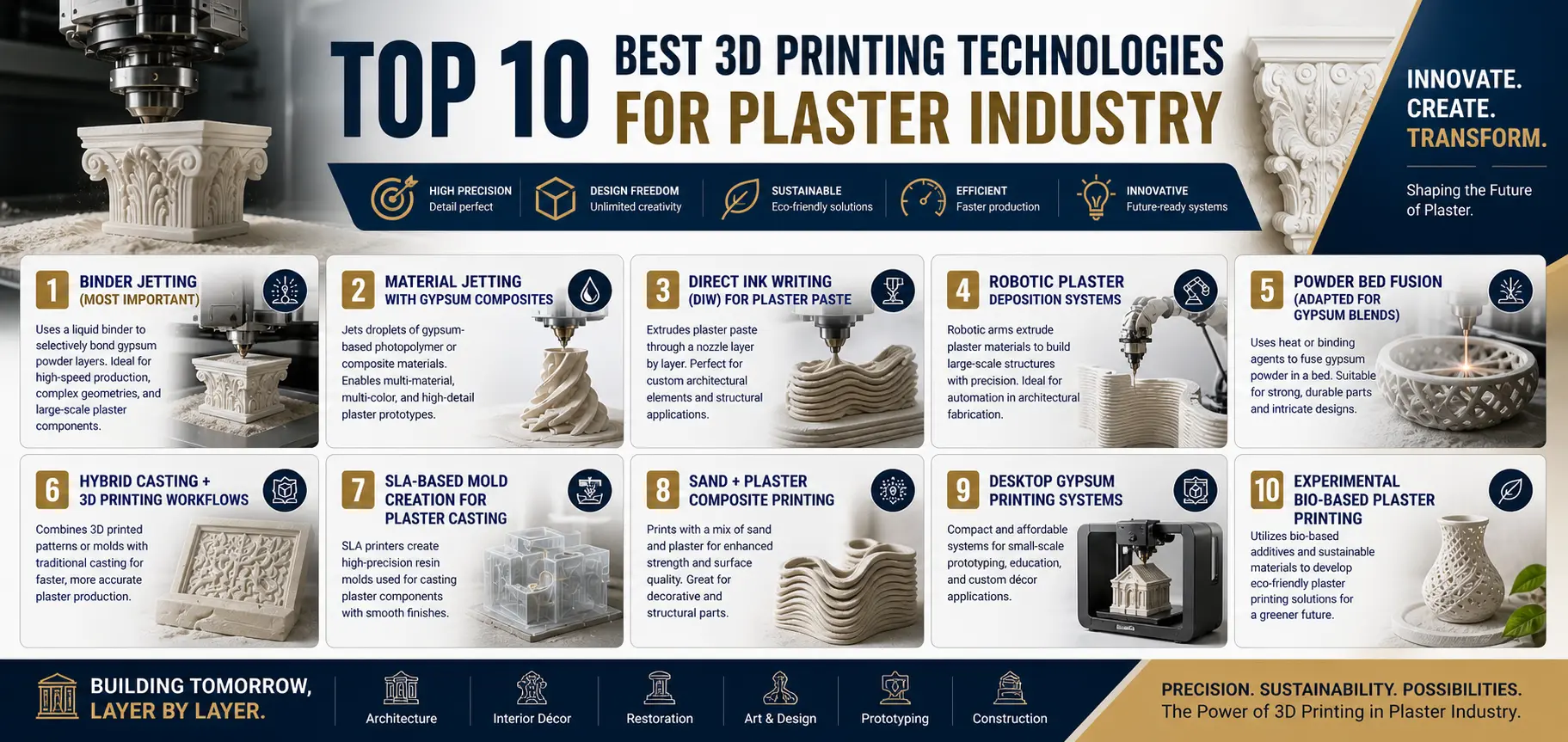
The landscape of plaster 3D printing is expanding rapidly, driven by its growing adoption across industries such as architecture, construction, healthcare, manufacturing, and education. While materials like resin and plastics dominate functional and high-strength applications, plaster continues to stand out for its affordability, scalability, and exceptional visual quality. Its ability to produce highly detailed, full-color models at a lower cost makes it especially valuable for presentation, prototyping, and casting workflows. From architectural models and medical replicas to industrial molds and heritage restoration, plaster 3D printing plays a critical role in applications where precision and aesthetics are more important than mechanical strength.
This guide explores not only how plaster 3D printing works but also why it remains highly relevant in modern manufacturing. It covers the top 10 technologies shaping the industry in 2026, including binder jetting, material jetting, DIW, robotic systems, and hybrid workflows, each offering unique advantages based on use case and scale. Along with practical insights, cost comparisons, and real-world applications, the blog highlights how advancements in automation, sustainability, and material innovation are shaping the future of plaster 3D printing - making it a key solution for industries seeking a balance between cost efficiency, design flexibility, and visual excellence.
Key Takeaways
-
Plaster 3D printing is cost-effective and scalable for visual-focused industries.
-
Binder jetting is the most widely used and efficient plaster printing technology.
-
Advanced methods are improving precision, scale, and production flexibility.
-
Plaster is best for visual models, not functional or load-bearing parts.
-
It is significantly cheaper than resin and nylon for large-scale models.
-
Supports full-color printing for high-quality presentation models.
-
Hybrid workflows combine 3D printing precision with casting strength.
-
Desktop systems make plaster 3D printing more accessible.
-
Bio-based materials are driving sustainability in plaster printing.
-
Future growth is driven by automation, AI, and large-scale construction use.
Introduction
Most people assume the future of 3D printing belongs entirely to high-strength plastics and resins, but that’s only half the story. In reality, plaster 3D printing continues to power some of the fastest-growing use cases in architecture, healthcare visualization, and design, where speed, scale, and visual precision matter more than mechanical strength. Technologies like binder jetting plaster have made it possible to produce full-color, highly detailed models up to 5–10x faster and significantly cheaper than traditional fabrication methods, making gypsum 3D printing a strategic choice rather than a legacy one.
According to Wohlers Terry, a leading voice in additive manufacturing, “binder jetting and material-based processes are expanding rapidly because they solve real production problems. speed, cost, and scalability.” This shift is clearly visible in industries such as architecture and real estate, where firms rely on 3D printing plaster to deliver presentation-ready models in hours instead of days. Similarly, experts like Hod Lipson have emphasized that the future of additive manufacturing isn’t about one dominant material, but about choosing the right process for the right application and plaster excels in its niche.
Plaster printing technologies really stand out because they can give you good results without being too expensive. Unlike materials like resin or nylon plaster lets you print in full color make complicated shapes and produce a lot of things without the cost getting too high. This makes plaster really useful for things like models of buildings molds for casting, replicas for use and tools for education, where how something looks is very important.
At the time people are coming up with new ideas to make plaster even better. There are now machines that can put plaster down in a way and new ways of working that combine different methods. They are also using a type of plaster that's better for the environment. These new developments are not making plaster 3D printing more precise and efficient but they are also making it a good choice for the future because it can work well with automated systems and is kind, to the earth.
In this guide, you’ll explore how plaster 3D printing works, why it remains highly relevant in modern manufacturing, and the top 3D printing technologies for plaster shaping the industry in 2026, along with real-world applications, comparisons, and insights into where this material is headed next.
What is 3D Printing in the Plaster Industry?
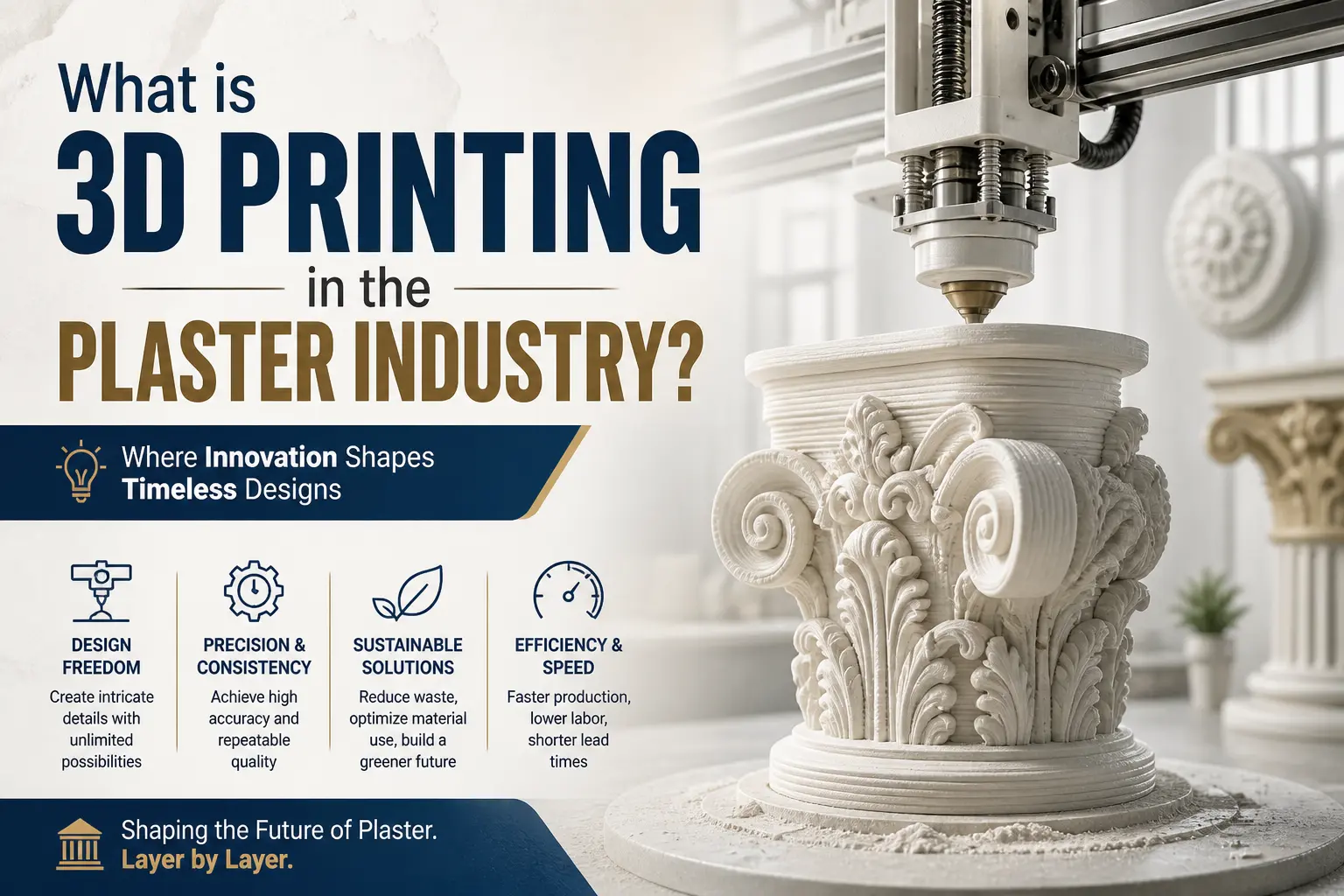
3D printing in the plaster industry is known to be a form of additive manufacturing based on gypsum materials. By using the powder and paste forms of plaster objects are built layer by layer. In this process convert the powder into a paste form by binding it with liquid and spread a thin layer of that paste depending on the technology used.
There is no extra tooling cost for highly complex changes and complicated design unlike the traditional manufacturing which also requires cutting and moulding, this makes it very cost efficient, effective and valuable for the industries that require critical detailing.
In practical applicability, 3D printing is extensively used in architectural models, casting models, medical equipment, and heritage restoration projects. For example, architectures can quickly create models in large scale production with the proper accuracy in color and texture, which is something that is difficult to do with the plastic materials
When compared to plastic printing, plaster offers a definite advantage in terms of cost and visual output. While plastics provide strength and durability, plaster comes in high quality and affordability, making it ideal for non-functional applications.
Why Plaster is Still Relevant in Modern 3D Printing
Even though with the rise of advance materials like resin and nylon, gypsum 3D printing still remain highly relevant as it solves a different set of problems like in cost efficiency and visually representation
One of the biggest advantages of plaster is its low cost per unit volume. While doing large scale production, such as architectural configuration or casting molds, material cost becomes an important factor. Plaster can be 3 to 5 times cheaper than resin or nylon material, making it the favourable choice for large-scale production.
Another key advantage is its ability to support full-color 3D printing. Technologies like binder jetting allow for color to be embedded directly into the print, which is extremely useful for presentation models, educational tools, and prototypes.
It also gives a sustainability advantage because gypsum is a mineral and can be recycled and used in many workflows. Gypsum has an edge. It also adjusts with the growing demand for eco-friendly 3D printing materials.
However, it is important to know that plaster 3D printing is not good for every use case. The plaster 3D printing is relatively fragile. That means gypsum is best suited for visual models and molds rather than functional or load-bearing parts made with gypsum.
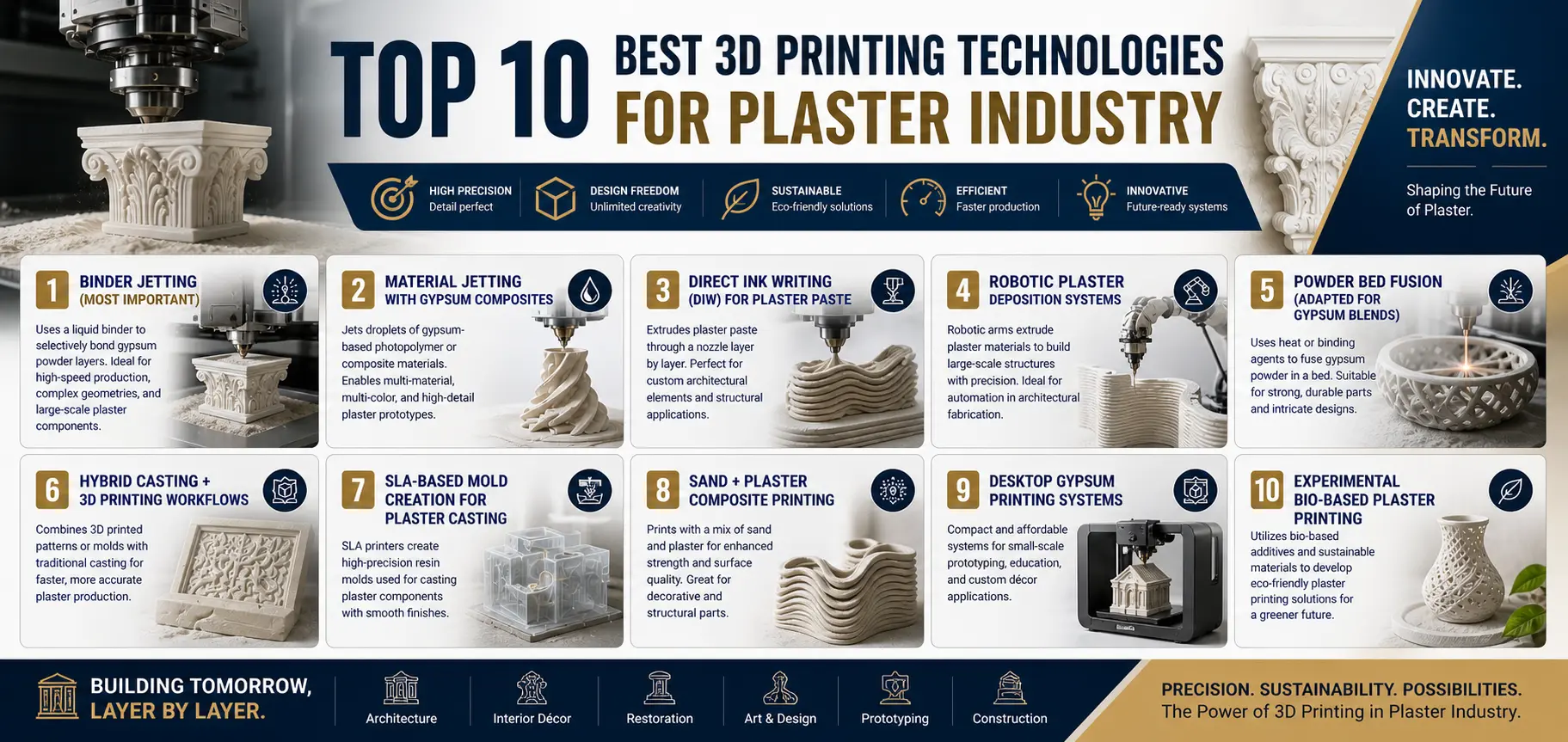
Top 10 Best 3D Printing Technologies for Plaster Industry
1. Binder Jetting
Overview:
Binder jetting is the most widely used technology in plaster 3D printing. It works by spreading a thin layer of gypsum powder and selectively applying a liquid binding agent to fuse particles together. This layer-by-layer process continues until the final object is formed. The technology is known for its speed and ability to produce detailed, full-color models efficiently.
Why It’s Ideal for the Plaster Industry:
Binder jetting perfectly suits plaster-based materials like gypsum due to its powder-based process. It allows manufacturers to create intricate shapes without support structures, making it highly efficient for complex designs. Its compatibility with color printing also makes it ideal for industries where visual detail and presentation are critical.
Key Advantages:
-
High-speed production compared to other 3D printing methods
-
Ability to create full-color models in a single print
-
Cost-effective for large-scale and detailed prototypes
-
No need for support structures due to powder bed system
-
Excellent detail and surface finish for visual models
Common Applications in 2026:
-
Architectural models for client presentations and urban planning
-
Real estate and construction visualization
-
Educational and museum display models
-
Customized figurines and artistic sculptures
-
Concept prototypes requiring color and fine detail
2. Material Jetting with Gypsum Composites
Overview:
Material jetting with gypsum composites is an advanced, hybrid 3D printing method that combines photopolymer jetting with plaster-like materials. It works by depositing tiny droplets of material layer by layer and curing them instantly, resulting in highly detailed and smooth finished parts.
Why It’s Ideal for the Plaster Industry:
This technology is ideal when plaster-based aesthetics are needed along with ultra-high precision. It allows manufacturers to achieve fine textures, sharp edges, and superior surface quality that traditional plaster printing methods may not deliver. It bridges the gap between visual realism and structural refinement.
Key Advantages:
-
Extremely high resolution and fine detail accuracy
-
Smooth surface finish with minimal post-processing
-
Ideal for complex and intricate geometries
-
Excellent visual and aesthetic quality
-
Suitable for premium and presentation-grade models
Common Applications in 2026:
-
High-end product prototypes and design validation models
-
Detailed architectural miniatures with refined finishes
-
Medical and dental visualization models
-
Luxury product design and concept modeling
-
Display models where surface quality and precision are critical
3. Direct Ink Writing (DIW) for Plaster Paste
Overview:
Direct Ink Writing (DIW) is an extrusion-based 3D printing technology where a viscous plaster paste is deposited layer by layer through a controlled nozzle. Unlike powder-based methods, DIW uses semi-liquid materials, allowing for continuous material flow and greater flexibility in shaping structures.
Why It’s Ideal for the Plaster Industry:
DIW is particularly suitable for plaster because it can handle thick, paste-like materials that closely resemble traditional plaster mixtures. This makes it ideal for large-scale builds and experimental designs, especially in architecture and construction where unconventional forms are desired.
Key Advantages:
-
Enables printing with real plaster paste and similar materials
-
Ideal for large-scale and construction-oriented applications
-
Supports organic, freeform, and complex geometries
-
Lower material waste compared to powder-based systems
-
Flexible and adaptable for experimental design processes
Common Applications in 2026:
-
Architectural research and experimental structures
-
Large-scale decorative installations
-
Construction components and facade elements
-
Sculptural and artistic projects with organic forms
-
Sustainable building prototypes and material experiments
4. Robotic Plaster Deposition Systems
Overview:
Robotic plaster deposition systems use programmable robotic arms to apply plaster materials in precise, controlled patterns. Unlike traditional 3D printers, these systems operate on a much larger scale, enabling the creation of architectural elements, wall sections, and even full structural components.
Why It’s Ideal for the Plaster Industry:
This technology aligns perfectly with the growing demand for automation in construction. Plaster, being versatile and widely used in building applications, can be efficiently handled by robotic systems to create complex forms at scale. It reduces manual labor while increasing consistency and precision.
Key Advantages:
-
Capable of producing large-scale architectural components
-
High precision and repeatability through robotic control
-
Reduces labor costs and manual intervention
-
Enables complex geometries not feasible with traditional methods
-
Scalable for industrial and construction-level production
Common Applications in 2026:
-
Automated construction of walls and facade systems
-
Large architectural installations and structural elements
-
Smart building components and prefabricated modules
-
Infrastructure and urban development projects
-
Experimental robotic construction and design innovation
5. Powder Bed Fusion (Adapted for Gypsum Blends)
Overview:
Powder Bed Fusion (PBF) is a high-energy 3D printing process where thermal sources, such as lasers, are used to fuse powder particles layer by layer. While it is primarily designed for metals and polymers, experimental adaptations have been developed for gypsum-based blends to explore new material capabilities.
Why It’s Ideal for the Plaster Industry:
Although not naturally suited for pure plaster, PBF becomes relevant when gypsum is combined with other materials to improve heat resistance and structural performance. This makes it useful in hybrid systems where enhanced strength and durability are required beyond traditional plaster capabilities.
Key Advantages:
-
Produces stronger parts compared to standard plaster printing methods
-
Enables use of hybrid gypsum-material composites
-
High precision and detailed geometry control
-
No need for support structures due to powder bed setup
-
Potential for advanced material innovation
Common Applications in 2026:
-
Research and development of hybrid gypsum materials
-
Functional prototypes requiring improved strength
-
Industrial design experimentation with composite powders
-
Specialized architectural components with enhanced durability
-
Academic and material science innovation projects
6. Hybrid Casting + 3D Printing Workflows
Overview:
Hybrid casting + 3D printing workflows combine additive manufacturing with traditional plaster casting. In this process, a mold is first created using 3D printing, and then liquid plaster is poured into the mold to form the final object. This approach leverages the strengths of both technologies - precision from 3D printing and material performance from casting.
Why It’s Ideal for the Plaster Industry:
Plaster is naturally well-suited for casting, and integrating 3D printing allows for the creation of highly complex, customized molds that would be difficult or expensive to produce using conventional methods. This makes the workflow highly efficient for both prototyping and batch production.
Key Advantages:
-
Combines precision of 3D printing with durability of cast plaster
-
Cost-effective for medium to large production runs
-
Enables complex geometries through custom mold design
-
Better surface finish compared to direct 3D printed plaster parts
-
Scalable for industrial manufacturing
Common Applications in 2026:
-
Production of decorative architectural elements
-
Customized sculptures and artistic pieces
-
Industrial components using plaster-based casting
-
Product prototyping and small-batch manufacturing
-
Interior design elements and bespoke decor pieces
7. SLA-Based Mold Creation for Plaster Casting
Overview:
Stereolithography (SLA) is a high-precision 3D printing technology that uses liquid resin cured by a laser to create extremely detailed molds. While it does not print plaster directly, it is widely used to produce molds that are later used for plaster casting, ensuring high-quality final outputs.
Why It’s Ideal for the Plaster Industry:
SLA is ideal for plaster workflows because it produces molds with exceptional accuracy and ultra-smooth surface finishes. This directly translates into cleaner, more refined plaster parts, making it especially valuable in industries where detail and finish are critical.
Key Advantages:
-
Ultra-high precision and fine detail reproduction
-
Smooth surface finish requiring minimal post-processing
-
Ideal for intricate and complex mold geometries
-
Consistent and repeatable mold quality
-
Enhances the final appearance of cast plaster parts
Common Applications in 2026:
-
Medical and dental models requiring high accuracy
-
Product design prototypes with fine detailing
-
Jewelry and small decorative item casting
-
High-end architectural miniature models
-
Custom components with intricate surface features
8. Sand + Plaster Composite Printing
Overview:
Sand + plaster composite printing is a specialized 3D printing approach used primarily in industrial foundries. It combines sand with plaster-based binders to create strong, heat-resistant molds and cores. These molds are typically produced using binder jetting-style processes and are designed to withstand molten metal during casting.
Why It’s Ideal for the Plaster Industry:
Plaster acts as an effective binding agent that enhances the cohesion and strength of sand molds. When combined, these materials offer improved dimensional stability and durability, making them suitable for high-temperature industrial applications where pure plaster would not perform well.
Key Advantages:
-
High heat resistance suitable for metal casting processes
-
Strong and durable mold structures
-
Enables complex internal geometries and cores
-
Reduces tooling time compared to traditional mold-making
-
Cost-effective for short-run and custom casting
Common Applications in 2026:
-
Metal casting molds and cores in foundries
-
Automotive and aerospace component manufacturing
-
Rapid prototyping of cast metal parts
-
Complex industrial casting designs
-
Custom and low-volume production tooling
9. Desktop Gypsum Printing Systems
Overview:
Desktop gypsum printing systems are compact, affordable 3D printers designed for small-scale plaster-based printing. They typically use simplified powder-binding techniques to create detailed models, making them ideal for entry-level users and low-volume production environments.
Why It’s Ideal for the Plaster Industry:
These systems make plaster 3D printing accessible to a wider audience, including students, designers, and small businesses. They allow users to experiment with gypsum printing without the high costs and complexity of industrial machines, helping drive innovation and adoption.
Key Advantages:
-
Affordable and accessible for beginners and small teams
-
Compact size suitable for offices, studios, and classrooms
-
Easy to operate with minimal technical expertise
-
Capable of producing detailed small-scale models
-
Lower material and operational costs
Common Applications in 2026:
-
Educational projects and hands-on learning
-
Concept modeling in design studios
-
Small business prototyping and product mockups
-
Customized figurines and creative products
-
Entry-level experimentation with plaster 3D printing
10. Experimental Bio-Based Plaster Printing
Overview:
Experimental bio-based plaster printing focuses on combining gypsum with natural, renewable, or biodegradable materials to create more sustainable 3D printing solutions. These may include plant fibers, organic binders, or waste-derived additives that enhance material performance while reducing environmental impact.
Why It’s Ideal for the Plaster Industry:
Plaster is already a relatively eco-friendly material, and integrating bio-based components further improves its sustainability. This approach aligns with the growing demand for green construction and responsible manufacturing, making it highly relevant for future-focused industries.
Key Advantages:
-
Reduced environmental impact and carbon footprint
-
Use of renewable and biodegradable materials
-
Potential for improved material efficiency and waste reduction
-
Supports sustainable construction and design practices
-
Encourages innovation in eco-friendly material science
Common Applications in 2026:
-
Sustainable architectural prototypes and eco-buildings
-
Green construction materials research and testing
-
Environmentally conscious product design
-
Academic and material innovation projects
-
Experimental installations and eco-art creations
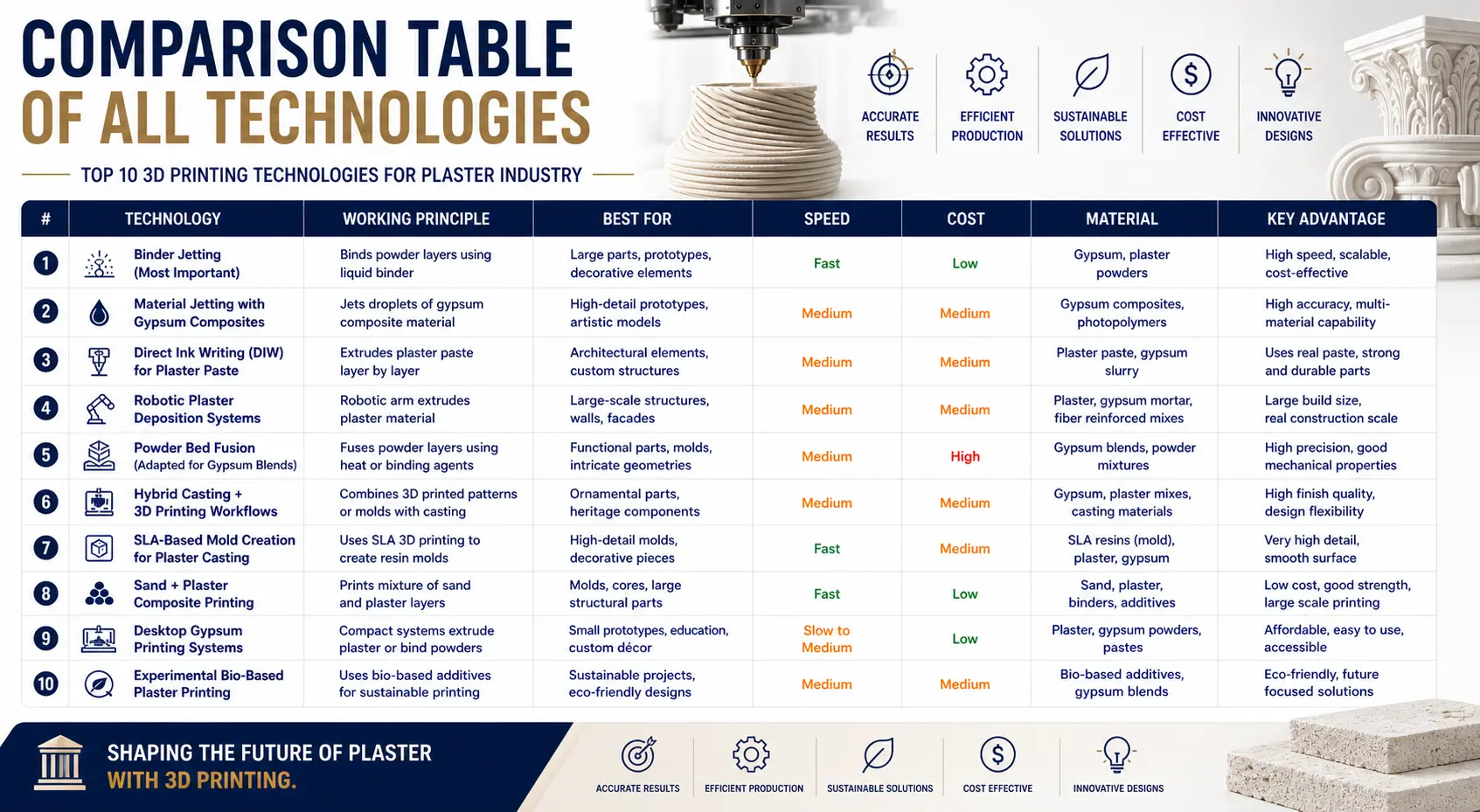
Comparison Table of All Technologies
|
Technology |
Cost |
Speed |
Accuracy |
Best Use Case |
|
Binder Jetting |
Low |
High |
Medium |
Architectural models |
|
Material Jetting |
High |
Medium |
High |
Detailed prototypes |
|
DIW |
Low |
Medium |
Medium |
Construction |
|
Robotic Deposition |
Medium |
High |
Medium |
Large structures |
|
Powder Fusion |
High |
Medium |
High |
Hybrid materials |
|
Hybrid Casting |
Low |
Medium |
High |
Industrial molds |
|
SLA Molds |
Medium |
Medium |
Very High |
Casting |
|
Sand Composite |
Medium |
High |
Medium |
Foundry |
|
Desktop Systems |
Low |
Low |
Medium |
Small models |
|
Bio-Based Printing |
Variable |
Low |
Experimental |
Sustainability |
Real-World Applications of Plaster 3D Printing
Plaster 3D printing plays a critical role across multiple industries due to its ability to produce detailed, cost-effective models.
In architecture, it is used to create scale models of buildings and cities, helping stakeholders visualize projects before construction begins. In healthcare, it enables the production of accurate anatomical models, which are used for surgical planning and medical education.
In manufacturing, plaster is widely used for casting molds, particularly in industries like automotive and aerospace. Additionally, it plays an important role in heritage restoration, where damaged artifacts and sculptures can be recreated with high accuracy.
Limitations of Plaster 3D Printing
While plaster offers many advantages, it also has clear limitations that must be considered.
The most significant drawback is its brittleness, which makes it unsuitable for applications requiring strength or flexibility. Plaster prints are also sensitive to moisture and often require post-processing treatments, such as sealing or infiltration, to improve durability.
Because of these limitations, plaster is best suited for visual and non-functional applications, rather than mechanical or load-bearing components.
Future Trends in Plaster 3D Printing
The future of plaster 3D printing is being shaped by advancements in automation, artificial intelligence, and sustainable materials.
AI-driven design tools are enabling the creation of optimized structures that reduce material usage while maintaining strength. At the same time, robotic systems are making it possible to scale plaster printing for construction and large architectural projects.
Sustainability is also becoming a major focus, with the development of bio-based and recyclable plaster composites.
How to Choose the Right Technology
Choosing the right plaster 3D printing technology depends on your specific needs, including budget, scale, and application.
If your priority is cost and speed, binder jetting is the best option. For high-detail models, material jetting or SLA-based workflows are more suitable. For large-scale construction or experimental designs, robotic deposition and DIW offer greater flexibility.
The key is to align the technology with your end-use requirements, rather than simply choosing the most advanced option.
Plaster 3D Printing Checklist (Decision Table)
|
Factor |
What to Check |
Why It Matters |
|
Use Case |
Visual model, mold, or prototype |
Plaster is best for non-functional applications |
|
Technology |
Binder jetting or hybrid workflow |
Determines speed, cost, and output quality |
|
Budget |
Cost per model or batch |
Plaster offers low-cost scalability |
|
Detail Requirement |
High resolution or standard |
Binder jetting supports intricate geometries |
|
Color Needs |
Full-color or single color |
Plaster excels in full-color 3D printing |
|
Size of Model |
Small, medium, or large format |
Plaster is ideal for large-scale models |
|
Strength Requirement |
Low or high durability |
Not suitable for load-bearing parts |
|
Post-Processing |
Sealing, infiltration, finishing |
Improves strength and appearance |
|
Production Speed |
Rapid or standard turnaround |
Faster than many other technologies |
|
Sustainability |
Material recyclability |
Gypsum supports eco-friendly workflows |
Author Bio
ForgeLabs is a leading name in advanced 3D printing and additive manufacturing, with over 15+ years of industry experience delivering high-quality solutions across architecture, manufacturing, and product development. Recognized as one of the best 3D printing companies in Australia,
Forge Labs specializes in plaster 3D printing, binder jetting, and industrial prototyping, helping businesses achieve faster production, cost efficiency, and exceptional visual results. With a strong focus on innovation, precision, and scalable workflows, Forge Labs continues to push the boundaries of modern manufacturing through cutting-edge 3D printing technologies.
FAQs
1. What is plaster 3D printing and how does it work?
Plaster 3D printing is an additive manufacturing process that uses gypsum-based powder layered and bonded using a liquid agent, most commonly through binder jetting plaster technology. It enables the creation of detailed, full-color models with high accuracy and speed.
2. What is binder jetting in plaster 3D printing?
Binder jetting plaster is a process where a liquid binding agent is selectively deposited onto a powder bed of gypsum material to form solid layers. It is one of the most widely used plaster 3D printing technologies for architectural and visual models.
3. Why is gypsum used in 3D printing?
Gypsum 3D printing is popular because it is cost-effective, supports full-color 3D printing, and allows fast production of complex geometries. It is ideal for applications where visual detail matters more than strength.
4. Is plaster 3D printing strong and durable?
No, plaster 3D printing produces parts that are relatively brittle compared to plastic or metal. It is best suited for visual prototypes, casting molds, and architectural models, rather than functional or load-bearing parts.
5. What industries use plaster 3D printing the most?
Industries that rely on 3D printing plaster include:
-
Architecture (scale models)
-
Real estate (visual presentations)
-
Healthcare (anatomical models)
-
Manufacturing (casting molds)
-
Education (learning tools)
6. What are the advantages of plaster over other 3D printing materials?
Compared to resin or nylon, plaster 3D printing technologies offer:
-
Lower cost per model
-
Faster production speed
-
Full-color capabilities
-
Better scalability for large models
7. What are the limitations of plaster 3D printing?
Key limitations include:
-
Low mechanical strength
-
Post-processing requirements
-
Sensitivity to moisture
Despite this, it remains highly effective for visual and presentation-based applications.
8. Can plaster 3D prints be waterproof?
Standard gypsum 3D printing parts are not waterproof. However, sealing and infiltration processes can improve water resistance and durability.
9. How does plaster 3D printing compare to resin 3D printing?
-
Plaster 3D printing → Better for full-color, cost-effective, large models
-
Resin printing → Better for fine mechanical details and strength
10. What is the future of plaster in additive manufacturing?
The future of plaster in additive manufacturing includes:
-
Robotic plaster deposition systems
-
Hybrid casting workflows
-
Sustainable gypsum materials
-
AI-driven production optimization
Final Thoughts
Plaster 3D printing has secured its position as one of the most practical and cost-efficient solutions within modern additive manufacturing, especially for industries driven by visual accuracy and scalable production. Among all plaster 3D printing technologies, binder jetting plaster continues to dominate due to its ability to produce highly detailed, full-color models at speed and low cost. This makes gypsum 3D printing a preferred choice for architectural models, real estate presentations, educational tools, and design prototypes where aesthetics and turnaround time are critical.
What sets 3D printing plaster apart is not just affordability, but its unmatched efficiency in producing large-format models without the material and time constraints seen in resin or nylon workflows. Compared to other 3D printing materials, plaster offers a compelling balance of cost per part, production speed, and visual fidelity, key factors for businesses focused on rapid prototyping and presentation-ready outputs.
At the same time, the landscape of plaster 3D printing technologies is rapidly evolving. Advanced methods such as material jetting with gypsum composites, robotic plaster deposition systems, and hybrid manufacturing workflows are pushing the boundaries of what’s possible. These innovations are enabling better precision, automation, and integration with traditional processes like casting and mold-making. In parallel, the emergence of sustainable 3D printing materials and bio-based gypsum solutions is aligning plaster with the growing demand for eco-friendly manufacturing.
That said, understanding the limitations of plaster 3D printing is equally important. Due to its brittle structure and lower mechanical strength, it is not suitable for functional or load-bearing parts. Instead, it excels in applications such as casting molds, architectural 3D printing, and visual prototyping, where detail, scale, and cost-effectiveness outweigh durability requirements.
The future of gypsum 3D printing is going to be different because of automation and computers that can design things better.
As companies try to make things faster and save money plaster-based 3D printing will still be very important. It helps people be creative and also makes things efficiently. For companies that want to use 3D printing with plaster they need to pick the way of doing it.
They have to choose between binder jetting or hybrid workflows depending on what they're making. This way gypsum 3D printing companies can get the most out of their money. Make things well. Gypsum 3D printing is going to be shaped by these things. Will be used for big construction projects.